

Products
Solutions
Ecosystems
Resources
Partners
Why Enterprise AI Needs a Semantic Layer for Governed Data
Short Answer
- Enterprise AI requires a governed semantic layer to ensure trusted, consistent outputs. By standardizing business logic, metric definitions, and data governance across every tool, workflow, and AI system, organizations can eliminate conflicting insights and establish a single source of truth.
- Fragmented business logic—not data quality or AI models—is the root cause of inconsistent analytics and AI results. A modern semantic layer centralizes definitions, relationships, and governance, enabling BI platforms, dashboards, applications, and AI agents to operate from the same trusted foundation.
- An independent, vendor-agnostic semantic layer improves scalability for both AI and analytics. By separating business logic from individual tools, enterprises can reduce reconciliation efforts, enforce governance consistently, accelerate self-service analytics, and deliver reliable AI-ready data across the entire data ecosystem.
Data Models are Failing, But Not for the Reason You Think
Enterprise analytics is at a turning point. As data volumes explode, enterprises are turning to AI-powered modeling to retrieve insights at unprecedented speeds.
But there's a blind spot: AI models don't naturally understand business strategy. They learn from raw datasets and inherit whatever business logic is embedded within them.
For an AI to deliver accurate, scalable insights, it requires governed, consistent business logic:
standardized metric definitions
strict operational rules
clear data categories
When this logic is trapped in siloed BI tools or buried in messy database tables, the AI gets confused. It doesn't just cause misalignment. It delivers inconsistent, untrustworthy answers that differ based on who you ask, undermining both data governance initiatives and confidence in AI-driven decision-making.
The Real Problem Is the Absence of Shared Business Logic
When a data model breaks, enterprises rarely question the foundation. Instead, they blame the most visible cracks across their tech stack:
"The data quality is bad"
"The AI model is hallucinating"
"The warehouse is too complex"
"We need better governance"
"Our teams use too many tools"
However, these symptoms all trace back to a single root cause: the lack of a shared, centralized business logic.
Specifically, it is the absence of governed metric definitions, attributes, relationships, and hierarchies across the enterprise data stack. Without a consistent framework for governed data, every tool, team, and AI system interprets information differently.
When this underlying logic varies for teams, BI dashboards, or AI workflows, alignment breaks down. Analysts receive different results for the exact same query, executive dashboards conflict, and AI systems confidently generate answers that do not align across business units.
In reality, the tech stack is rarely broken. It's simply operating on logic that isn't consistent, centralized, or governed at the enterprise level.
Visible Issue | Actual Problem |
Data quality issues | No unified layer defining consistent logic across data sources |
AI inconsistency | AI pulls from conflicting datasets and definitions because there is no single source of truth |
Data warehouse complexity | The warehouse only exposes the absence of shared, enforceable data logic |
Weak data governance | Governance exists in documentation, not as governed data logic inside the architecture itself |
Tool fragmentation | Business logic is redefined independently across tools and teams |
Without Data Governance, AI Becomes a Self-Scaling Problem
Once enterprises realize the issue starts at the foundation, the symptoms finally make sense. But while fragmented logic causes friction in human-driven workflows, AI turns that friction into a repeatable enterprise problem.
Human analysts can spot an anomaly, question a weird number, or schedule an alignment meeting to reconcile differences. An AI model cannot. It simply generates answers based on the business and data logic it consumes.
This creates a dangerous ripple effect across the enterprise:
The AI begins reinforcing and automating inconsistent interpretations at machine speed
Tracking down which version of the business logic AI used becomes difficult across disconnected tools
Analysts get dragged back into a manual cycle of reconciling conflicting AI results
If speed and accuracy are the reasons enterprises are investing in AI-powered data modeling, they must understand this: you can't train AI on a fractured data layer and expect governed, consistent outputs.
To scale AI successfully, the focus must shift away from trying to fix surface-level dashboards. Instead, enterprises must fix how data logic and business logic are defined, unified, and governed across the entire data stack.
Why this matters:
In a human-only workflow, a slightly mismatched calculation might cause a minor debate in a meeting. But when you plug an AI model directly into that same flawed foundation, it will accelerate the misalignment across every connected workflow. Without a way to govern and unify data logic, scaling AI models for new tools and teams becomes a blocker instead of an opportunity.
What Is a Semantic Layer for AI and BI (And Why Enterprises Need It)
To break the cycle of manual reconciliation and AI inconsistency, organizations are turning to a critical piece of data architecture: the modern semantic layer.
A semantic layer sits directly between your raw data infrastructure and the consumers using it. It translates complex database tables and columns into standardized, plain-language business concepts like Revenue, Active Customers, or Churn Rate, so every dashboard, application, and AI system works from the same definitions.
Instead of relying on individual tools or teams to interpret data independently, a semantic layer creates a single source of truth where those definitions are locked in, governed, and uniformly applied.
But for enterprises relying on legacy BI infrastructure, this poses a challenge: most traditional semantic layers are trapped inside specific BI tools, limiting how governed business logic can be reused in the broader data ecosystem.
When your metrics and logic are written in a proprietary format (like Power BI's DAX), they cannot be read by Tableau, Python notebooks, or a downstream AI model. The moment data moves outside that specific tool, those definitions must be rebuilt, revalidated, and maintained all over again, creating additional governance overhead and opportunities for inconsistency.
Why this matters:
This fragmented approach completely fails in modern enterprise environments that manage thousands of data sources. To scale, enterprises don't just need a semantic layer for a single dashboard. They need a governed semantic layer with consistent business logic that is universally accessible across the entire data stack.
The Benefits of An Independent Semantic Layer for BI and AI
Rather than sitting trapped inside a single frontend tool, a modern semantic layer operates as an independent, centralized architecture across your entire data stack, making governed data accessible wherever it is needed.
It standardizes business logic, bridges disparate data sources, and extends governed definitions outward to every downstream system. This decouples your business logic from the tools that display it, allowing both enterprise analytics and AI-powered analytics initiatives to operate from the same trusted foundation.
Why this matters:
Whether a metric is queried by an executive dashboard, a custom data application, or an AI model generating a real-time answer, the underlying definition remains identical because it is governed centrally rather than recreated locally.
Because the logic is centralized, updates happen in a single place. A change to a KPI calculation is made once and instantly reflected everywhere, eliminating the need to manually rebuild definitions for multiple pipelines.
Furthermore, security and access controls can be governed directly at this logic level, ensuring that both human users and automated AI agents strictly operate within consistent, predefined boundaries aligned with enterprise governance policies.
In other words, the semantic layer becomes the definitive, vendor-agnostic control center for how enterprise data is understood, trusted, and utilized across the entire organization, regardless of which BI tools, applications, or AI systems consume it.
Strategy Mosaic delivers an independent, vendor-agnostic semantic layer that integrates directly into your existing data stack. Define your business logic once, govern it centrally, and deploy it consistently across all BI tools, data systems, and AI workflows, ensuring every analytics and AI experience is grounded in the same trusted definitions.
How a Governed Semantic Layer Transforms Your Workflows
Once an independent semantic layer is applied across the data stack, much of the friction inside your data operations disappears.
Instead of forcing engineers to rebuild metrics inside every individual dashboard or report, definitions are locked in at the core and distributed consistently across workflows.
This semantic layer fundamentally changes how AI systems operate within the organization. Instead of forcing LLMs and AI agents to generate outputs from fragmented, messy tables, your models operate strictly within a governed layer of definitions.
Before a modern semantic layer | After a modern semantic layer |
|---|---|
Metrics defined separately across tools | Metrics defined once and reused everywhere |
AI outputs vary across teams | AI outputs grounded in consistent, governed logic |
Logic tied to specific BI tools | Logic shared across the entire data stack |
Conflicting dashboards | Consistent outputs across all tools |
Manual validation and reconciliation | Aligned data by default |
Why this matters:
Your analysts stop acting as data detectives spending hours validating numbers and finally get to spend their time using them to drive strategy. Executive dashboards stop conflicting because they are no longer pulling from different interpretations of the same database tables. Teams spend less time debating definitions and more time acting on trusted insights. Data reconciliation efforts are dramatically reduced because governed logic is applied consistently across the environment.
Next Steps: Building a Governed Foundation for BI and AI
If your tech stack can't agree on what your data means, that inconsistency spreads through every connected tool and application. It fragments human workflows and weakens AI outputs, making it difficult to trust your insights or act on them with confidence.
Fixing this requires a fundamental shift in how organizations approach data architecture.
Instead of treating business logic as something managed inside individual tools, it must be defined once at the core and applied consistently across the entire environment.
An independent semantic layer enables this shift by completely separating your business logic from the tools that consume it, ensuring that the same definitions support a semantic layer for BI, analytics applications, and AI systems alike.
It moves the focus away from constantly validating numbers and fixing fragmented data, creating a sustainable environment where both human teams and automated AI systems operate within clearly defined, trusted, and governed boundaries.
If your data logic is tied to a specific BI tool or vendor, your analytics and AI capabilities inherit those limitations as well. When evaluating an independent semantic layer, the key is choosing one that keeps your logic consistent across every tool, system, and use case.

Tanmay Ratanpal
A copywriter and brand strategist with 8+ years of experience turning ideas into compelling content. He blends sharp messaging with smart storytelling to build brands that connect, spark conversations, and (mostly) win your boss’s approval.
Content:
- Data Models are Failing, But Not for the Reason You Think
- The Real Problem Is the Absence of Shared Business Logic
- Without Data Governance, AI Becomes a Self-Scaling Problem
- What Is a Semantic Layer for AI and BI (And Why Enterprises Need It)
- The Benefits of An Independent Semantic Layer for BI and AI
- How a Governed Semantic Layer Transforms Your Workflows
- Next Steps: Building a Governed Foundation for BI and AI
Related posts
Learn the five core components of an AI-ready semantic layer architecture and how unified business logic, governance, and semantic consistency improve enterprise AI accuracy, scalability, and trust.
Tanmay Ratanpal
June 9, 2026
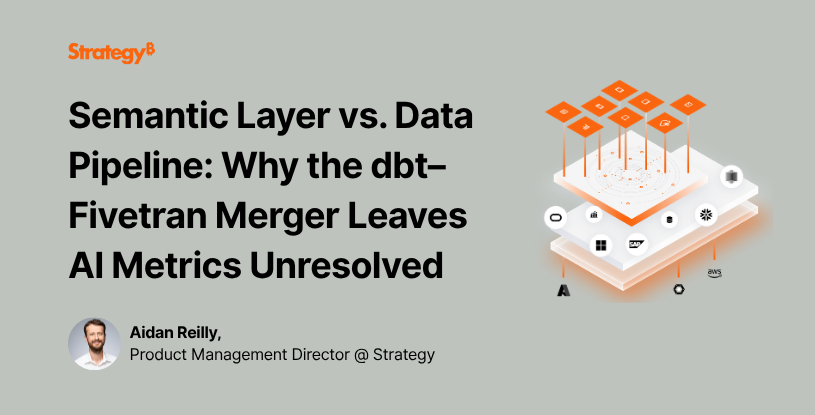
The June 2026 dbt Labs-Fivetran merger consolidates data ingestion and transformation, but trusted AI agents still need a governed semantic layer. Strategy Software explains why owning the pipeline isn't owning the meaning, and where Strategy Mosaic fits.

Aidan Reilly
June 8, 2026
Enterprise AI fails when organizations skip the prior work and go straight to model selection. The three questions every team should answer before any tool gets selected, from Strategy Software's Juliana Schoettler.

Juliana Schoettler
June 8, 2026
Learn how a semantic layer differs from a data model and why both are essential for governed analytics and AI. Discover how Strategy Mosaic creates consistent business definitions, reusable metrics, and trusted AI-ready data across BI tools, warehouses, and enterprise systems.
.png&w=750&q=75)
Emily Murphy
May 20, 2026