

Products
Solutions
Ecosystems
Resources
Partners
SEMANTIC LAYER COMPARISON HUB
Semantic Layer Comparison: Strategy Mosaic vs AtScale, Cube.dev, dbt Labs, Denodo, and Looker
Stop rebuilding your metrics. Define them once, trust them everywhere across every warehouse, BI tool, and AI agent.
This page compares Strategy Mosaic with AtScale, Cube.dev, dbt Labs, Denodo, and Looker across the capabilities buyers care about most: semantic foundation, governance, AI readiness, federation, self-service modeling, interoperability, and pricing. It reflects Strategy Software’s assessment of current capabilities as of April 2026.
QUICK ANSWER — WHICH SEMANTIC LAYER FITS YOUR TEAM?
Strategy Mosaic is built for enterprise teams that need governed metrics trusted by business users, data engineers, and AI agents across every warehouse and BI tool. Mosaic Studio provides AI-powered no-code modeling, and Mosaic Sentinel delivers continuous governance across semantic-layer query activity.
If you are also evaluating AtScale, Cube.dev, dbt Labs, Denodo, or Looker, this page covers where each fits. For enterprise teams prioritizing governed metrics across BI tools, data platforms, and AI agents, Mosaic is the strongest fit.
INDUSTRY RECOGNITION
Recent third-party recognition from Gartner Peer Insights, G2, and selected industry awards programs.

Sources: Gartner Peer Insights, G2 Enterprise Grid Reports, VIP Awards Program. Ratings reflect published data as of 2025.
STRATEGY MOSAIC BUSINESS IMPACT
These outcomes reflect operational gains reported by Strategy Mosaic customers, including lower warehouse compute costs from semantic-aware caching, less duplicated metric maintenance across tools, faster KPI delivery, and more reliable AI outputs grounded in governed business definitions.
551%
Average ROI
$3.4M
Average net annual impact
22%
Fewer AI hallucinations
46%
End-user time reclaimed
44%
Fewer redundant metrics
Sources: UserEvidence ROI research across retail, telecom, and financial services customers, and CIO Dive Studio 2026 survey of 100 senior data leaders at organizations with $2B or more in revenue.
EVALUATION CRITERIA
What to Look for When Evaluating a Semantic Layer
Use these criteria to evaluate any semantic layer, including Mosaic. The capability table below shows how each vendor scores across these dimensions.
REQUIRED AT THE ENTERPRISE TIER
- Business glossary with governed metric definitions
- Bidirectional integration with analytics platforms
- Federated semantic model across multiple data sources
- Low-code or no-code semantic modeling interface
- Data virtualization — query execution without physical data movement
- In-memory caching to reduce underlying platform compute costs
- AI integration: calculated metrics, context modifiers, and prompt grounding
EMERGING CAPABILITY DIFFERENTIATORS
- Agent memory: persistent semantic context shared across multiple LLM sessions
- AI reasoning within the bounds of governed business definitions
- Data graph and ontological context for richer semantic relationships
- Knowledge graph integration spanning processes, rules, and applications
- Observability instrumentation linked to business KPI impact, not query volume
Strategy Mosaic: See your data, unified.
Book a demo tailored to your data stack.
CAPABILITY COMPARISON
Strategy Mosaic vs AtScale, Cube.dev, dbt Labs, Denodo, and Looker
Ratings reflect current production capabilities as of April 2026, including documented limitations where relevant.
Strategy MosaicUniversal Semantic Layer | AtScaleEnterprise USL + MDX / OLAP | Cube.devHeadless API-first | dbt LabsTransformation + MetricFlow | DenodoData virtualization | LookerLookML / BI platform | |
SEMANTIC FOUNDATION | ||||||
Business glossary and metric definitions | Full | Full | Full | Partial | Partial | Full |
Reusable metrics and joins across sources | Full | Full | Full | Partial | Partial | Full |
Schema on write (governed defintions) | Full | Full | Full | Full | Partial | Full |
ACCESS AND PERFORMANCE | ||||||
Universal BI tool and connectivity | Full | Full | Full | Partial | Full | Partial |
In-memory caching and query acceleration | Full | Partial | Full | Partial | Partial | Partial |
Smart caching (semantic-aware query result reuse) | Full | Full | Full | Partial | Partial | Full |
Data virtualization (federated query) | Partial | Partial | Partial | — | Full | Partial |
Cross-platform federation (multi-warehouse) | Full | Full | Full | Partial | Full | Partial |
MODELING AND USER EXPERIENCE | ||||||
Visual no-code modeling interface | Full | Partial | Partial | — | — | — |
AI-powered model authoring and suggestions | Full | — | — | Partial | — | Partial |
Business user self-service | Full | — | Partial | — | — | Partial |
Git-based version control | Full | Full | Full | Full | Full | Full |
YAML authoring support | Building | Full | Full | Full | — | — |
GOVERNANCE AND ENTERPRISE | ||||||
Lineage, versioning, and ownership | Full | Partial | Partial | Full | Partial | Partial |
Cross-platform governance (Snowflake Horizon, Databricks Unity Catalog, and others) | Full | Partial | Partial | — | Partial | Partial |
Standalone governance across BI tools and AI agents (Mosaic Sentinel) | Full | Partial | Partial | Partial | Partial | Partial |
Predictable per-user pricing | Full | — | Partial | Partial | — | Partial |
Data catalog integration (Collibra, Alation, Atlan) | Full | Partial | Partial | Partial | Partial | Partial |
AI AND AGENT READINESS | ||||||
Governed semantic context for LLMs and AI agents | Full | Partial | Partial | Partial | Partial | Full |
Context and prompt modifiers | Full | — | — | — | — | Partial |
Unlimited token usage for AI and agent workloads | Full | — | — | — | — | — |
Agent memory and shared reasoning context | Building | — | — | — | — | — |
ADDITIONAL DIMENSIONS | ||||||
MDX and Power BI native support | Full — native XMLA | Best-in-class MDX | MDX API (preview) + DAX API | Power BI; no native MDX | MDX service available | Power BI; no native MDX |
OSI membership | Joined Sep 2025 | Joined Jan 2026 | Launch participant (Sep 2025) | Launch participant (Sep 2025) | Joined Mar 2026 | Google joined Nov 2025 |
AI and LLM integration | AI-Powered Modeling + MCP | MCP + AI chatbot | Cube AI + MCP | dbt MCP + Copilot | DeepQuery NL | Gemini + MCP |
Source and methodology: Strategy Software assessment based on public vendor materials, competitive analysis, and internal product review. Full = production capability. Partial = capability exists with limitations or scope constraints. Building = active roadmap. — = outside stated scope. Product information current as of April 2026.
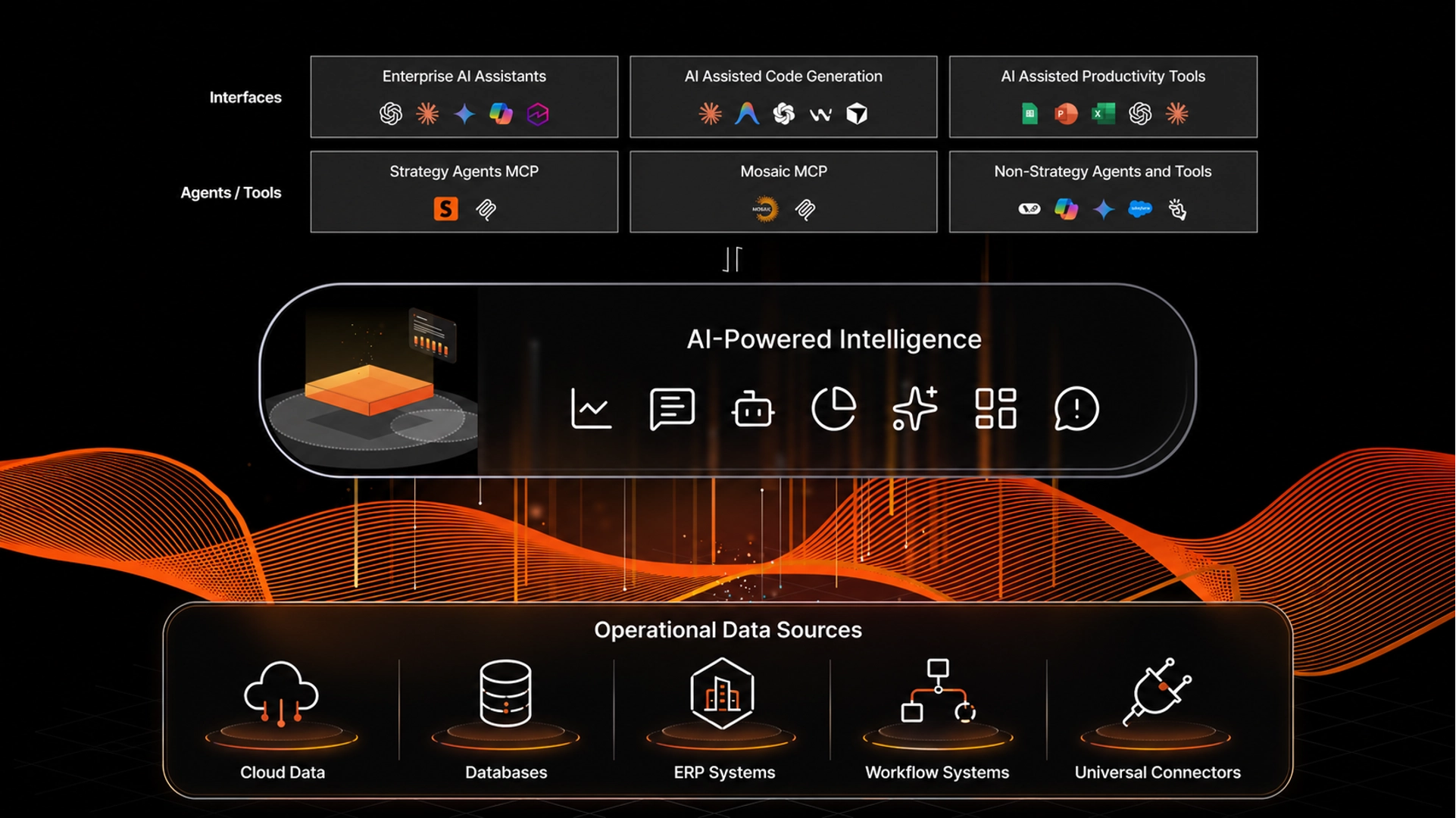
HOW MOSAIC FITS IN YOUR STACK
Strategy Mosaic Sits Between Your Data and Every Consumer
One semantic layer serves BI tools, AI agents, custom apps, and spreadsheets — without duplicating logic in any of them.
DETAILED COMPARISONS
Go Deeper on Each Evaluation
Each spoke page will cover architecture trade-offs, migration considerations, proof points, and FAQs specific to that vendor pairing.
MOSAIC VS ATSCALE
Pricing, MDX, and Semantic Governance
Evaluating both on MDX support, governance depth, and what you'll pay as deployment grows? This page covers where AtScale leads, where Mosaic differs, and how their pricing models compare at scale.
MOSAIC VS CUBE.DEV
Embedded Analytics vs Business Self-Service
Cube.dev is the right choice for developer teams building embedded analytics and API-first data products. If you also need business users to create and govern metrics without writing code, this page explains what changes.
MOSAIC VS DBT LABS
MetricFlow vs Enterprise Semantic Layer
Already using dbt? This page explains what MetricFlow covers, where it stops, and what Mosaic adds on top of your existing dbt setup — without requiring you to replace anything.
MOSAIC VS DENODO
Data Virtualization vs Semantic Governance
Denodo connects your data sources without moving data. Mosaic adds consistent business definitions and governed metrics on top. This page covers how the two work together — and when you need both.
MOSAIC VS GOOGLE LOOKER
LookML vs Universal Semantic Layer
Already using Looker? This page explains where LookML is strong, where it stays tied to the Looker and Google stack, and what Mosaic adds for teams that need governed metrics and semantic consistency across multiple tools, platforms, and AI consumers.
“People don’t trust metrics unless it comes from Strategy.
It’s become the golden record.”
Senior Manager of Reporting and Insights · Fortune 500 omnichannel retail network · UserEvidence ROI Study, 2026 · Strategy Software customer
FREQUENTLY ASKED QUESTIONS
Questions Buyers Ask at This Stage
Does Mosaic replace AtScale, Cube.dev, dbt Labs, Denodo, or Looker?
Usually not. Mosaic can work alongside existing tools by providing an independent semantic layer above them. Teams may use Mosaic above dbt transformations, with Denodo as the connectivity layer, alongside Cube.dev APIs, or next to Looker as a cross-platform semantic foundation. In AtScale environments, Mosaic may add broader business-user authoring, continuous governance, and consistency across BI tools and AI agents. The right architecture depends on which tool owns transformation, connectivity, BI delivery, and governed metric definitions.
How does Mosaic pricing compare with AtScale, Cube.dev, Denodo, and Looker?
Mosaic uses named-user pricing rather than per-object, API-volume, or consumption-based pricing. AtScale pricing should be modeled against deployed semantic objects such as metrics and attributes. Cube.dev pricing can vary by plan and usage, including API and platform consumption. Denodo pricing is generally tied to usage, capacity, or deployment scope. Looker pricing is typically enterprise-negotiated and tied to the broader BI platform deployment, including user types, edition, and Google Cloud environment. These differences matter more as semantic-layer adoption expands across more domains, users, applications, and AI use cases.
How long does it take to get value from Mosaic?
With the right scope, teams can usually deliver an initial result within 6 to 8 weeks. Full enterprise rollout is typically a longer program. The best starting point is one contested KPI, validated across tools and stakeholders, before expanding further.
What does Mosaic Sentinel do that AtScale, Cube.dev, dbt Labs, Denodo, and Looker do not?
Mosaic Sentinel provides continuous governance and observability across governed query activity from BI users, applications, and AI agents. It helps teams monitor usage, detect anomalies, identify sensitive-data exposure risks, attribute cost by semantic object, and maintain audit trails for MCP-based agent interactions. Other tools provide governance within their own semantic layer, BI platform, virtualization layer, or transformation workflow. Sentinel is different because it brings query visibility, policy monitoring, semantic cost attribution, and agent auditability together in one continuous governance layer.
What does Power BI and MDX support look like across Mosaic, AtScale, Cube.dev, dbt Labs, Denodo, and Looker?
Mosaic provides native MDX and DAX support through XMLA, making it a strong fit for Power BI and Excel-heavy enterprise environments. AtScale is also strong for MDX-heavy and OLAP-style environments. Cube.dev provides native Power BI connectivity through its DAX API and supports Excel/PivotTable-style access through its MDX API. dbt Labs supports Power BI connectivity to the dbt Semantic Layer, but it does not provide native MDX. Denodo offers MDX service capabilities for OLAP-style access. Looker supports Power BI through connector-based workflows, but it does not provide native MDX. For Power BI-primary organizations where MDX depth, XMLA compatibility, and enterprise semantic governance matter, Mosaic and AtScale remain the strongest fits.
How does Mosaic compare with Google Looker and LookML?
Looker is strong for governed BI and semantic modeling within a LookML-centric Google Cloud environment. Mosaic is different because it provides an independent semantic layer for governed metrics, business definitions, and AI context across multiple BI tools, warehouses, applications, and agents. Looker is strongest when analytics runs through Looker; Mosaic is strongest when semantic governance must span a heterogeneous BI and AI stack.
Why does AI need a semantic layer?
AI needs a semantic layer when business definitions matter. Without governed definitions for metrics like revenue, margin, or active customer, AI can return answers that are technically correct but semantically wrong. A semantic layer gives AI the same trusted business logic that BI tools and analysts use.
What is a semantic layer and why do I need one?
A semantic layer is a software layer that sits between source data systems and the tools, teams, and agents that consume that data. It provides governed definitions for metrics, hierarchies, and business concepts so every BI tool, application, and AI agent uses the same logic. Without a semantic layer, each tool defines shared metrics independently, which creates inconsistency and reconciliation work.
What is the difference between a semantic layer, a metrics layer, and headless BI?
A metrics layer focuses on how measures are calculated. A semantic layer is broader: it includes metrics, hierarchies, relationships, governance, ownership, and delivery to every consumption tool and AI agent. Headless BI is an architectural pattern in which governed definitions are exposed through APIs instead of being tied to a single visualization layer. Strategy Mosaic supports headless BI API consumption while also providing a native visual interface for users who do not interact via API.
What is the difference between a semantic layer and data virtualization?
Data virtualization solves the connectivity problem: how to query across sources without moving data. A semantic layer solves the meaning problem: how to define metrics and business logic consistently across tools. The two are complementary, which is why Denodo and Mosaic are often deployed together.
Evaluate Strategy Mosaic Against Your Actual Data and Criteria
We recommend starting with a single contested KPI and a scoped proof of value, not a generic demo.