

Products
Solutions
Ecosystems
Resources
Partners
Day 2 at World 2026: Reinventing enterprise software
Day 2 of World 2026, Strategy’s premier annual event, was defined by bold thinking and big-picture transformation. The agenda was packed with visionary keynotes, customer success stories, and high-impact networking—from energetic breakfast discussions to an evening celebration that kept the conversations going.
Three funerals and a wedding: A wake-up call for enterprise tech
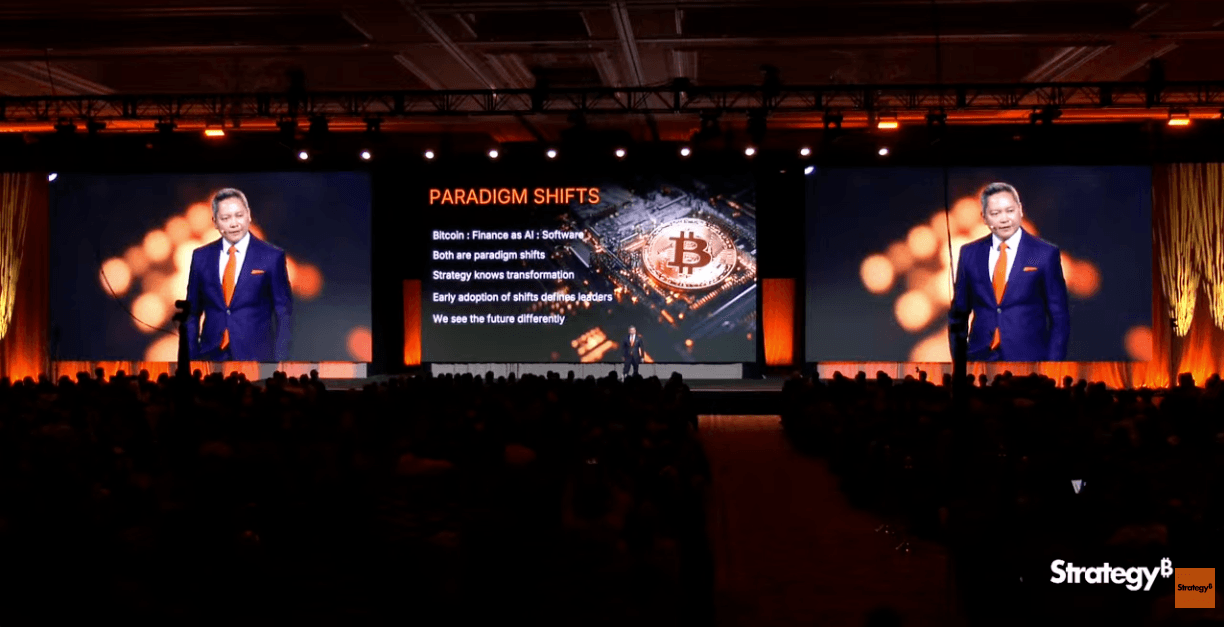
In his bold keynote, “Three Funerals and a Wedding,” Phong Le delivered a clear message: the foundations of enterprise software, as we’ve known them for the past 20 years, are reaching their limits. Incremental change is no longer enough, fundamental transformation is overdue.
Sunsetting technologies
Phong outlined a critical timing mismatch between today’s business demands and yesterday’s technology architecture. Three core pillars of enterprise software are approaching end-of-life:
- SaaS systems have become expensive, poorly integrated, and underutilized, despite consuming roughly 10% of IT budgets.
- Business Intelligence has stagnated, with adoption hovering around 20%. Static dashboards built for analysts can’t meet the need for real-time, autonomous decision-making.
- Data warehousing has devolved into what Phong called “data prisons”: costly, rigid systems that take 18+ months to deploy and risk becoming obsolete before they’re fully implemented.
“SaaS is really a 2000s answer to a 2026 problem.”
— Phong Le, President & CEO, Strategy
The AI-powered shift
According to Phong, the path forward lies in combining AI with a robust semantic layer that provides business context, governance, and personalization, capabilities that today’s standalone AI systems lack.
Rather than relying on dashboards and human interpretation, the future belongs to intelligent agents operating in real time:
“A human looking at a better graph with underlying data is dead. An agent, or a set of agents, communicating with each other, with direct real-time access to the business context, processing underlying data and making autonomous decisions. That’s the answer.”
— Phong Le, President & CEO, Strategy
This shift promises to replace dashboard-driven BI with proactive, streaming intelligence, while dramatically reducing reliance on expensive data warehousing infrastructure. The result: potentially hundreds of millions in savings and a fundamentally new enterprise software model.
The abstraction revolution
Following Phong’s keynote, EVP & Chief Product Officer Saurabh Abhyankar took the stage with “Freedom to Innovate,” exploring a powerful idea: human progress is driven by abstraction.
From language to mathematics to modern software engineering, which has achieved 22,000x productivity gains, abstraction has consistently unlocked exponential progress.
Data engineering, however, has lagged behind. Productivity improvements have plateaued at roughly 600x since SQL’s introduction. The result? Persistent friction. Every new report or insight still demands heavy manual effort, even as software development becomes increasingly automated.
“The difference between productivity that we’ve seen in data engineering and software engineering is huge.”
— Saurabh Abhyankar, EVP & Chief Product Officer, Strategy
Mosaic: The brain of the enterprise
Saurabh presented Mosaic as the solution: a semantic abstraction layer capable of encoding business logic and serving as the “brain” of the enterprise.
By pairing this business abstraction layer with advanced AI, organizations can automate both:
- Above the layer: insights, reports, applications
- Below the layer: data materialization, querying, and optimization
Instead of manually engineering pipelines and dashboards, teams operate at the semantic business level, while AI handles the technical complexity underneath, much like modern programming languages abstract away binary code.
“If you can describe how a business runs in the semantics and then put advanced AI alongside that, you can automate enormous parts of your business.”
— Saurabh Abhyankar, EVP & Chief Product Officer, Strategy
Breakthrough Mosaic innovations
Saurabh and his team showcased several groundbreaking capabilities:
- Model Linking: Connecting domain models (sales, marketing, finance) into a unified enterprise fabric
- Auto-Translation: One-click translation of semantic layers into multiple languages
- Learning & Personalization: Adapting to usage patterns to create tailored experiences for individuals and departments
- Open Semantic Interchange: YAML-based export/import with Git integration and version control
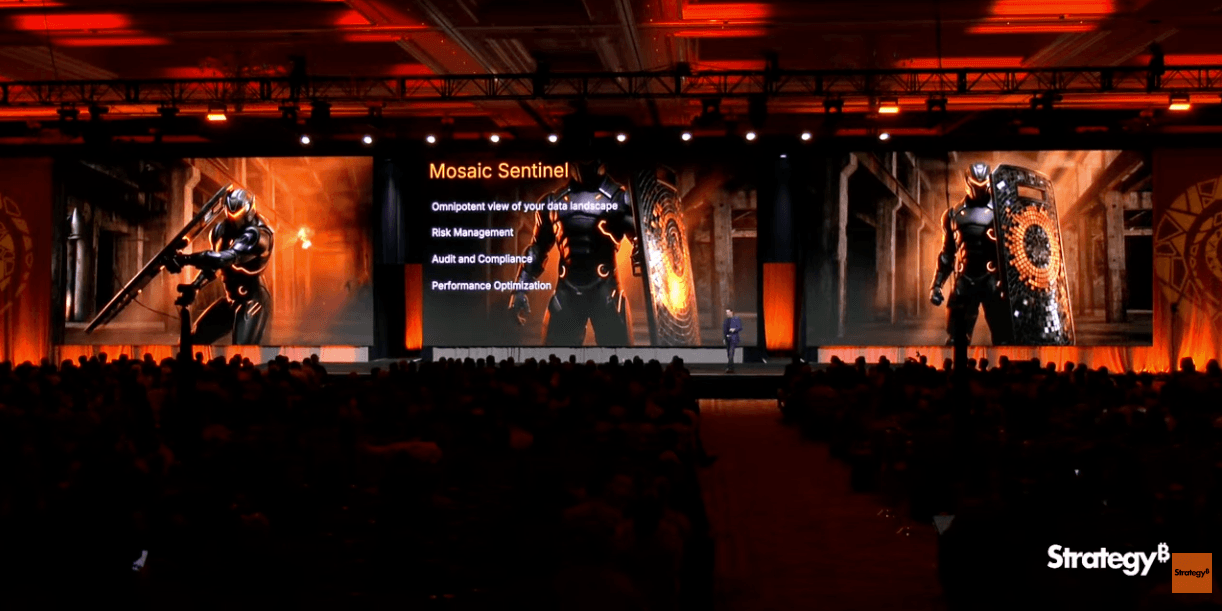
- Mosaic Sentinel: A governance suite spanning risk management, audit/compliance, usage insights, performance optimization, and cost intelligence
- Ontologies: Advanced modeling with relationships, rules, hierarchies, workflows, and descriptions—creating a true digital twin of the business
Partner power: AI-first enterprise at scale
The day also highlighted Strategy’s ecosystem partnerships, particularly with AWS and Google.
AWS: From experimentation to production agents
Chris McNabney from AWS emphasized that the era of AI experimentation is ending. The future lies in production-ready AI agents capable of making multimillion-dollar decisions with reliability and governance.
He described scenarios where AI agents resolve supply chain disruptions before executives arrive at work, or rebuild financial forecasts in real time during board meetings, all powered by the AWS-Strategy Mosaic partnership that provides critical business context to AI systems.
Google: Embracing the AI moment
Jim Fairweather, Head of AI GTM at Google, brought a refreshingly human perspective. His advice? Experiment boldly, and have fun with AI. He revealed that Gemini Enterprise became Google’s fastest-growing product ever, selling 8 million seats to 2,800 companies in just four months.
According to Jim, companies fall into three categories: ostriches with heads in the sand, those missing the AI bus, and pace setters for tomorrow’s industries.
The message was clear: the window to lead is open, but it won’t stay open forever.
Learn how Strategy’s universal semantic layer enforces business meaning and grounds enterprise AI in governed logic.
What's next?
World 2026 has wrapped, but the energy is still building.
To everyone who joined us in Las Vegas—thank you. And to those who tuned in from afar, we hope the excitement came through loud and clear.
Couldn’t catch the 2026 World keynotes live?
They’re now available to watch on demand.

Beata Socha
With over 15 years of experience as a tech journalist and content creator, Beata heads Content Marketing at MicroStrategy. An economics graduate, she specializes in finance and the impact of AI on business, bringing expert insights to the industry.
Related posts

Strategy World 2026 Day 1 recap from Las Vegas: 1,500+ enterprise leaders explore AI, the Universal Semantic Layer, corporate Bitcoin strategy, and the future of enterprise software in the AI era.
Beata Socha
February 24, 2026

Discover how Strategy Mosaic transforms the enterprise semantic layer for the AI era—eliminating metric drift, unifying siloed data, automating governance, and grounding AI analytics in a single trusted source of truth.

Tanmay Ratanpal
February 18, 2026
Enterprise AI fails without a semantic layer that enforces shared business meaning. Discover how Strategy Mosaic delivers governed, accurate, production-ready AI.
Tanmay Ratanpal
February 18, 2026
Discover how the world’s leading brands are transforming AI, analytics, and cloud modernization at Strategy World 2026. Explore real customer success stories from Pfizer, Porsche, TD, Diageo, Deutsche Telekom, and more as they share how Strategy’s Universal Semantic Layer and AI-powered solutions drive measurable business impact.
Tanmay Ratanpal
December 9, 2025