

Products
Solutions
Ecosystems
Resources
Partners
Why enterprise AI fails without a semantic layer for AI
Enterprise AI initiatives often stall not because of weak models, but because they lack a semantic layer that enforces shared business definitions, governance, and context across systems. By centralizing and standardizing meaning, an AI-ready semantic layer turns fragmented data and experimental pilots into reliable, production-grade intelligence.
As AI integrates deeper into data analytics, executive concerns have shifted from “How do we adopt AI?” to “Why isn’t it delivering value?”
Despite billions invested in large language models, copilots, and autonomous agents, many enterprise AI initiatives stall in what has become known as PoC purgatory. The pilots impress. The demos look promising. But production impact never materializes.
The models are not the problem. The missing piece is a semantic layer for AI that enforces shared business meaning.
What is a semantic layer for AI?
A semantic layer for AI is an enforceable business logic layer that ensures AI systems interpret enterprise data according to shared definitions, hierarchies, metrics, and governance rules.
Traditional AI systems can access data from multiple sources, but they cannot unify business context or enforce consistent logic. AI models can’t reconcile what “revenue,” “profit,” or “active customer” mean across teams.
A semantic layer for AI embeds business meaning directly into the data environment. It centralizes definitions, enforces governance rules, and standardizes context across tools, teams, and AI systems.
Without it, AI operates on raw information rather than trusted meaning.
Why traditional semantic layers are not built for AI
Most traditional semantic layers were built for dashboards and human-led analysis, not AI-driven reasoning. They standardize reporting, but they don’t enforce logic and context.
In practice, traditional semantic layers fall short in a few critical ways:
- They’re tightly coupled to individual BI tools, which makes logic inaccessible to AI systems operating outside those environments
- They apply governance after queries are generated, not while AI is reasoning through data
- They document definitions instead of enforcing them, leaving AI to understand logic on the fly
As AI begins generating queries, joining datasets, and defining metrics by itself, these gaps are magnified across the entire BI ecosystem.
What makes a semantic layer for AI different?
A modern, AI-ready semantic layer functions as infrastructure for AI, delivering four critical features:
- Machine enforceable definitions that AI systems can't bypass
- Real-time security and governance enforcement
- Decoupling from any single BI tool or data warehouse
- Universal accessibility across human and AI consumers
Instead of allowing AI to interpret business logic dynamically, the semantic layer defines that logic once and enforces it everywhere. This reduces hallucinations, prevents KPI drift, strengthens AI data governance, and ensures consistent reasoning across the enterprise.
An AI-ready semantic layer isn’t reactive. It’s a proactive, enforceable foundation designed to ground both humans and AI in the same business meaning.
That’s the role Strategy Mosaic is designed to play.
How Strategy Mosaic functions as a semantic layer for AI
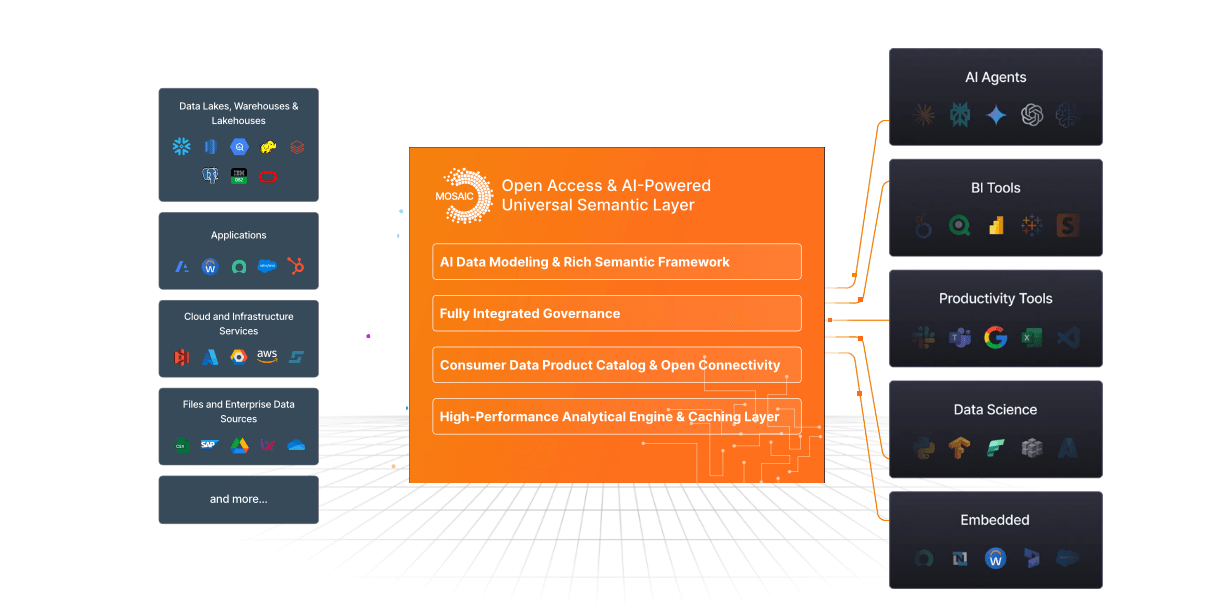
Strategy Mosaic is designed to operate as a universal semantic layer that grounds enterprise AI systems in shared meaning.
1. Eliminates hallucinations by centralizing reasoning
Rather than relying on retrieval and guesswork, Mosaic provides machine enforceable semantic objects that large language models (LLMs) use as reference points.
As a result, AI no longer guesses. It reasons within guardrails.
Why it matters: Industry research by dataworld shows that grounding the LLM in a semantic layer can improve query accuracy from 16 percent to above 50 percent.
2. Ensures security and governance in real-time
Mosaic enforces governance at the foundational layer itself. If a user does not have permission to access a metric, the AI agent won't generate an answer. Security filters are applied before the AI’s reasoning begins, not after.
This strengthens AI data governance while maintaining flexibility across the organization. Sensitive metrics remain accessible only to authorized users, even when queried through AI.
Why it matters: Data exposure is the #1 concern for executives deploying generative AI. Analysts at Forrester consistently highlight that a semantic layer must act as a security guardrail.
3. Ensures true tool agnosticism
Business logic should not be trapped inside a single visualization tool or cloud warehouse.
As our CPO Saurabh Abhyankar notes, “Mosaic is built to give enterprises freedom. You define your business logic once within Mosaic and consume it anywhere”. Mosaic allows enterprises to define metrics and business logic once and consume them across Strategy One, Power BI, Tableau, or custom AI agents.
This decoupling reduces vendor lock-in and ensures that your semantic layer for AI remains portable across evolving ecosystems.
Why it matters: One of the most persistent causes of data fragmentation is vendor lock-in. Organizations sign 15-, 20- year contracts with vendors that can increase operation and maintenance costs, while the company is unable to adopt newer, cost-efficient solutions.The architecture below illustrates how Strategy Mosaic connects data sources, governance, and AI consumers into one enforceable framework.
The 2026 verdict: Own your meaning
The era of experimental AI is ending. Organizations need measurable, scalable outcomes that deliver reliable analytics for each department. Traditional semantic layers can’t offer a flexible, governable foundation that drives long-term impact.
A semantic layer for AI ensures that every AI agent and human analyst operate on the same definitions, hierarchies, and governance rules. It transforms enterprise AI from isolated experimentation into core enterprise infrastructure.
Strategy Mosaic transforms fragmented data into enforced clarity. It consolidates data, logic, and context into a trusted AI data foundation that enables governed, production-ready AI across the enterprise.
Learn how Strategy’s universal semantic layer enforces business meaning and grounds enterprise AI in governed logic.
FAQ: Semantic layers and enterprise AI
What is a semantic layer for AI?
A semantic layer for AI is an enforceable business logic layer that standardizes definitions, metrics, and governance rules so that AI systems interpret data consistently across the enterprise.
How does a semantic layer prevent AI hallucinations?
It grounds large language models in predefined business objects and relationships, preventing AI from dynamically constructing logic or guessing table joins.
Is a traditional semantic layer enough for generative AI?
Most traditional semantic layers were designed for dashboards and reporting.
They document definitions but often do not enforce them during AI reasoning.
Does a semantic layer replace a data warehouse?
No. A semantic layer sits above data warehouses and BI tools. It defines and enforces business meaning across them.
Why is AI data governance important?
Without real-time governance enforcement, AI systems may expose restricted metrics or generate inconsistent results. A semantic layer for AI ensures permissions and definitions are respected before outputs are produced.

Tanmay Ratanpal
A copywriter and brand strategist with 8+ years of experience turning ideas into compelling content. He blends sharp messaging with smart storytelling to build brands that connect, spark conversations, and (mostly) win your boss’s approval.
Related posts

Semantic data modeling is the missing foundation for enterprise AI. Learn how a universal semantic layer and semantic model automation unify business logic, prevent KPI drift, and deliver trusted, consistent AI and analytics across every team and tool with Strategy Mosaic.
Tanmay Ratanpal
February 13, 2026

Discover Strategy Mosaic—the AI-powered Universal Intelligence Layer that unifies your data ecosystem. Eliminate silos, enforce governance, and deliver consistent, trusted insights across every BI tool. Future-proof your data strategy and accelerate AI adoption with Mosaic.

Lauren O’Connor
July 30, 2025
Discover how Strategy Mosaic, the world’s first Universal Intelligence Layer, revolutionizes data management with AI-powered modeling, tri-open architecture, and built-in governance for scalable, future-ready analytics.
Tanmay Ratanpal
July 7, 2025
Discover how Mosaic helps CEOs plan for the next decade—unlocking agility, lowering TCO, and powering AI-ready decisions through a flexible, governed data foundation.

Beata Socha
June 25, 2025