
Products
Solutions
Ecosystems
Resources
Partners
Connect Any AI to Your Governed Data with MCP and Mosaic
Model Context Protocol (MCP) allows your AI tools to tap into external data sources. Mosaic provides the business logic your tools need to give that data meaning. With Mosaic and MCP, you can unlock governed, consistent answers - no custom integrations required.

Works with your AI tools



MCP-compatible out of the box
See what a governed AI data layer looks like in practice.
How Mosaic gives AI agents a governed data foundation
Mosaic is a semantic layer that sits between your data warehouse and the tools that consume it. It doesn't move your data. It defines how your data gets interpreted, who can access it, and how fast it gets served.
One metric definition. Every tool.
Define revenue, churn, CAC, or any business metric once in Mosaic. Every BI dashboard, AI agent, and analyst query resolves to the same number — because they're all reading from the same semantic model.
MCP Integration: Mosaic exposes your semantic layer to AI tools via the Model Context Protocol — so Claude, Copilot, and any MCP-compatible tool reasons over governed business definitions, not raw SQL. And because the semantic layer is the constant, you can swap LLMs without re-modeling your data or reconciling your metrics.
AI safety and governed access, built in
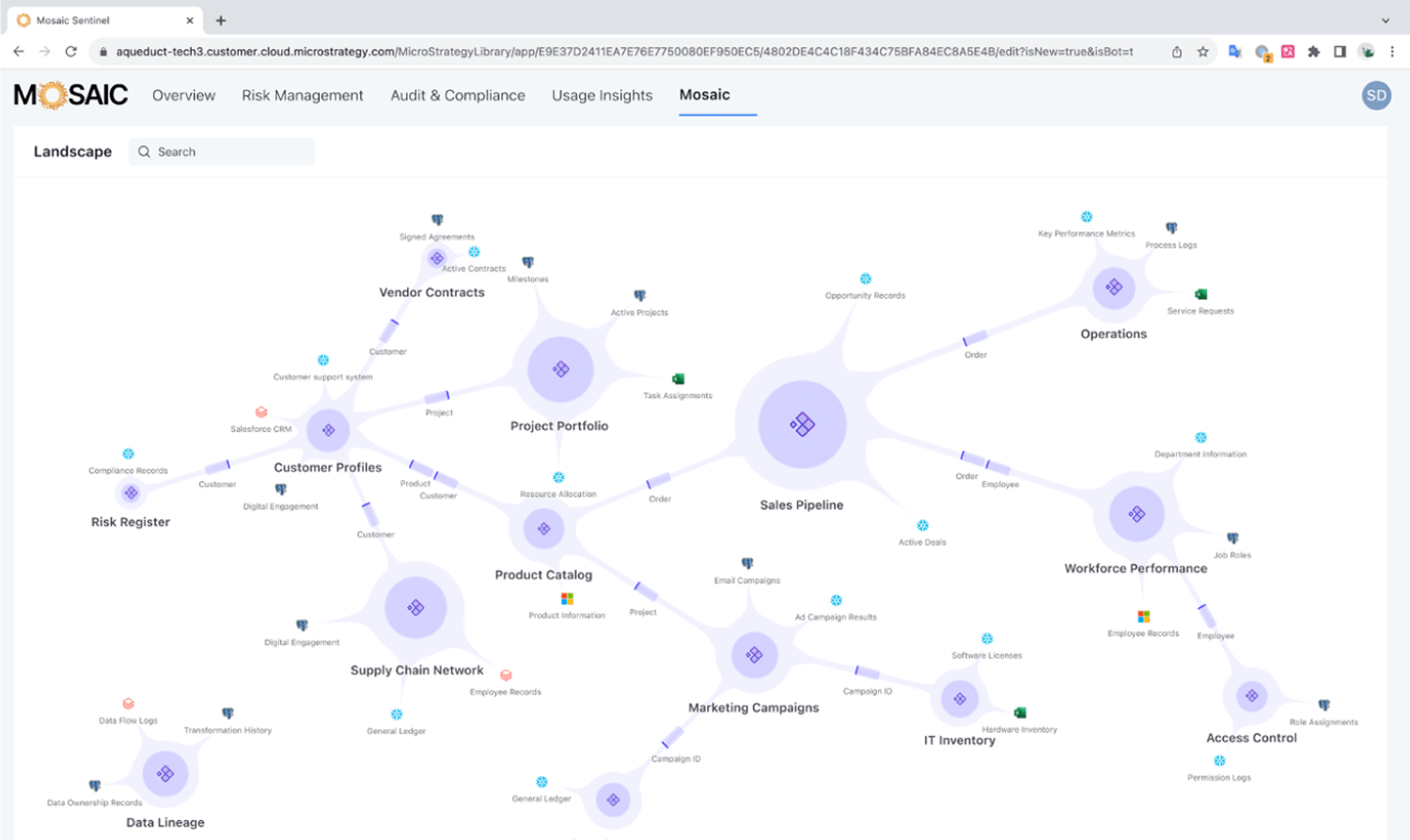
Mosaic Sentinel is your AI safety layer. Define exactly which datasets AI tools can reach including hard boundaries around PII and sensitive data. Sentinel tracks every query made through the semantic layer, by humans and AI agents alike, giving you a full audit trail for compliance without rebuilding your warehouse access controls. And because agents only ever see clean, scoped, governed data, you eliminate a root cause of hallucination at the source.
A governed semantic model in 30 minutes
Schema creation that used to take a day now takes 30 minutes. Connect a data source, describe what you're modeling, and Mosaic Studio generates the joins, attributes, and relationships that’s ready for AI tools to query immediately.
What a governed AI data layer looks like in production
What does this look like when it's running?
AI Agents Grounded in Logic
Connect Claude, Copilot, or any MCP-compatible agent to your Mosaic semantic layer. LLMs answer questions using your actual business definitions, not whatever the raw SQL happens to return.

Consistent Metrics Across Every Tool
Power BI, Tableau, and Looker all resolve to the same revenue and KPI definitions. No more reconciliation meetings when numbers don't match across dashboards.

Build AI apps on trusted data — without a data engineering dependency
AI teams can build and ship applications grounded in governed business data without waiting on engineering to model it first. Connect a source, generate the semantic model in Mosaic Studio, and start building — your app is querying real, consistent business logic from day one.

Data Governance & AI Observability
Define exactly which datasets AI tools and analysts can access. Mosaic Sentinel logs every query for compliance without touching your existing warehouse security model.
White Paper: Implementing Enterprise AI at Scale
Mosaic exposes your semantic layer to AI agents via the Model Context Protocol. To see how this standardizes communication between your warehouse and LLMs like Claude or Copilot, download our whitepaper.