

Products
Solutions
Ecosystems
Resources
Partners
A Faster Model on Fragmented Data Just Produces Wrong Answers Faster
Quick Overview: Enterprise AI adoption is not a single wave. The pendulum swings, and CIOs are split between pushing hard on deployment and building the foundation first. At a recent roundtable at the IDC CIO Summit in New York, Strategy Software heard both sides make the same underlying argument from opposite directions. The one thing nearly every leader agreed on: without a governed semantic layer, neither approach scales safely.
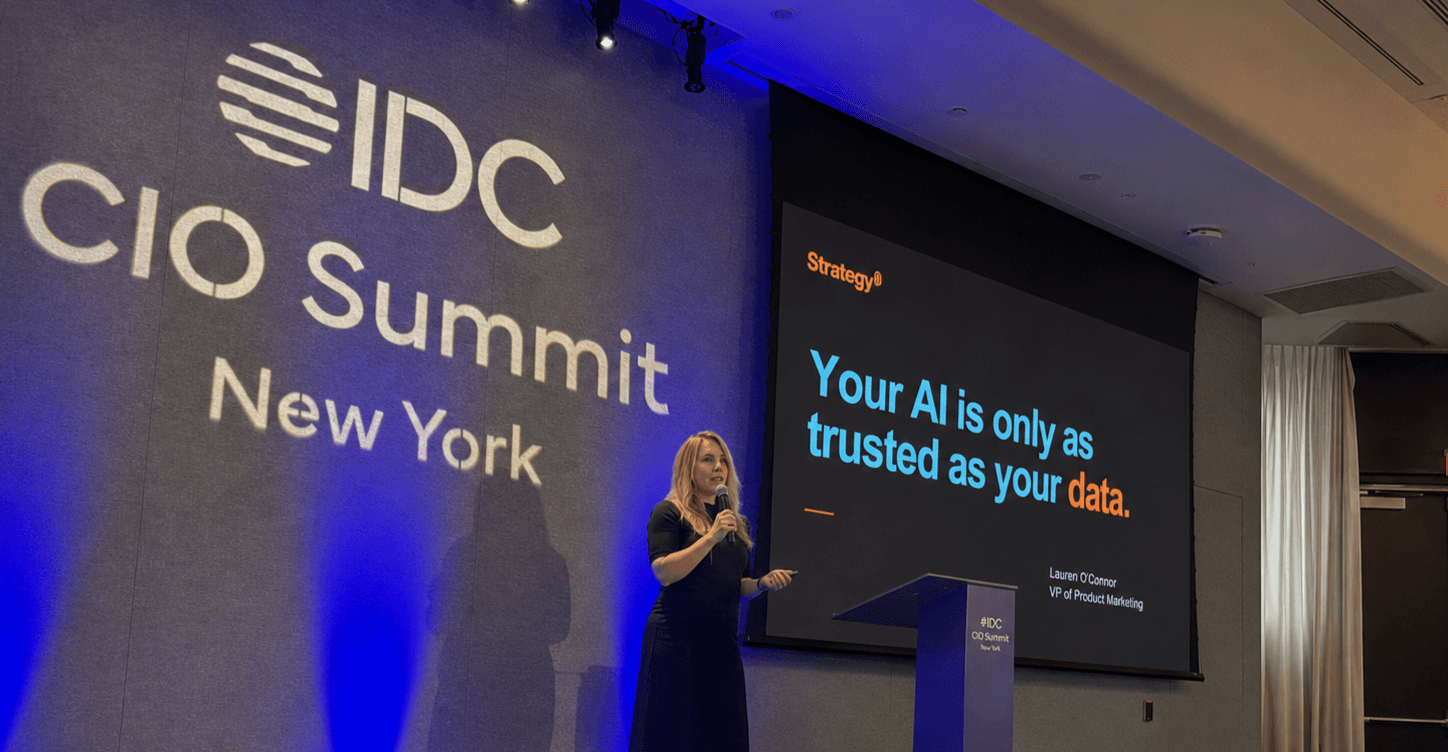
I recently had the chance to moderate a roundtable at the IDC CIO Summit in New York on behalf of Strategy Software, an enterprise AI+BI analytics platform. The topic was data and AI. The attendees were senior technology leaders from some of the most recognizable organizations in the country, representing financial services, pharma, public sector, media, and more.
What I expected was a room largely aligned on the urgency of AI. What I found was something more honest and, frankly, more useful: a room split between those ready to swing the pendulum hard toward AI-first and those determined to slow it down until the foundation was right. Both sides turned out to be making the same argument from different angles.
Here is what I took away.
The Pendulum Is Real, and Both Sides Have a Point
Both camps are right. The tension between fast movers and careful builders is not a disagreement about the value of AI. The real disagreement is about what adequate preparation looks like, and that is a much more productive conversation than it first appears.
Every CIO in that room had pressure on them. The pressure to move faster. The pressure to show ROI. The pressure to not be the person who let the organization get left behind.
But the responses to that pressure looked very different depending on who you talked to.
Some leaders were fully committed to acceleration. Hiring for AI fluency. Orienting team culture around experimentation. Treating momentum as a competitive asset. The philosophy: get in the game now and govern as you scale.
Others were doing the opposite. Slowing deliberate deployments. Requiring human review at key checkpoints. Asking hard questions about data provenance before anything went to production. The philosophy: the cost of a wrong answer at scale is too high to move before the foundation is right.
Both groups were right. And hearing them in the same room made it clear why.
The One Thing Everyone Agreed On
Despite landing in very different places on pace, the roundtable converged quickly on one point: you cannot trust AI output if you cannot trust the data underneath it.
Every leader in that room had a version of this story. The model that returned conflicting answers depending on which team ran the query. The dashboard that looked right until a regulator asked where the numbers came from. The AI recommendation that could not be traced back to a definition anyone in the organization actually owned.
The language varied. The problem was the same: fragmented, ungoverned, inconsistent data flowing into AI tools that were never designed to compensate for it.
My presentation was built around exactly this observation, and hearing it reflected back from practitioners confirmed what Strategy Software sees across enterprise deployments: the bottleneck is almost never the model. It is the semantic layer, or the absence of one.
What "Going Fast" Actually Requires
The leaders who are accelerating AI successfully are not cavalier about data quality. The ones doing it well have made a specific architectural bet: define your critical business metrics in one place, enforce those definitions across every tool, and let every AI application inherit from that single source of truth. That is not a constraint on speed. That is what makes speed safe.
The pattern is consistent across the organizations in that room that had already scaled AI successfully. Before deployment came a foundational decision.
What AI-ready organizations do differently:
Define metrics centrally. Revenue, margin, customer, risk: one definition, enforced across every tool. No team maintains its own version.
Enforce governance at the semantic layer, not at the tool level. Row-level and column-level security applied once, inherited everywhere, rather than configured separately in each BI or AI application.
Connect data sources to the semantic layer, not directly to applications. When schemas change upstream, only one layer needs updating. The dashboards, reports, and AI agents reading from it stay intact.
Require traceability before any AI output reaches a decision. Every AI recommendation must trace back to a governed definition. If it cannot, it does not ship.
Strategy Mosaic, Strategy Software's universal semantic layer, is built around exactly this architecture. Connect once across 200+ data sources, define business logic once in Mosaic Studio, and every AI tool, every dashboard, and every agent inherits from that definition. When schemas change upstream, Strategy Mosaic absorbs the update. The rest of the stack stays intact.
One theme that came up repeatedly was the difference between organizations that had invested in a governed semantic layer before scaling AI and those that had not. The ones that built the foundation first were moving faster, not slower, because they were not rebuilding context with every new use case. Their AI tools did not hallucinate on the definition of revenue. Their agents returned consistent answers across markets. Their field teams acted on AI recommendations with confidence.
What "Slowing Down" Is Actually Protecting
The more cautious leaders were not opposed to AI. They were protecting something specific: the integrity of decisions made on AI output.
For some, this meant requiring subject matter expert review before any AI-generated content went external. For others, it meant refusing to deploy AI in any domain where the underlying data was not clean and traceable. For the public sector leaders in the room, it meant working through regulatory constraints that made governance not a preference but a legal requirement.
What these leaders understood is that speed without traceability is not actually speed. It is debt. Every unaudited AI decision is a decision that cannot be defended when something goes wrong. In regulated industries, in high-stakes commercial environments, in any context where a wrong answer has real consequences, the ability to trace an AI output to its source data is not optional infrastructure. That traceability is the whole point.
What I Brought Back
Moderating that roundtable reinforced something I think about every time I talk to enterprise leaders about AI readiness. The pendulum framing is useful, but it can obscure what really matters. The leaders succeeding on both ends of the spectrum, the fast movers and the careful builders, share one trait: they have made a deliberate decision about their data foundation.
The ones struggling are not the ones moving too fast or too slow. They are the ones deploying AI on top of ungoverned data and hoping the model compensates for the mess underneath it. It does not. A faster model on fragmented data just produces wrong answers faster.
The good news from that room: there was genuine appetite to solve the right problem. These leaders understand that AI trust is a data governance question before it is a model question. Getting there is the right starting point.
If you want to talk through what a governed semantic layer looks like in your environment, reach out. Strategy Software works with enterprises across industries navigating exactly this, and the playbook exists whether you are trying to move fast or move carefully.
See how Strategy Mosaic gives your AI a governed foundation to build on.

Frequently Asked Questions
Q: What is an AI adoption pendulum in the enterprise?
A: The AI adoption pendulum describes the range of approaches enterprise leaders are taking to AI deployment, from aggressive acceleration to deliberate, governance-first caution. Strategy Software observes that the most successful organizations are not at either extreme; they are building governed data foundations that make sustainable AI deployment possible regardless of pace.
Q: Why do enterprise AI initiatives fail to reach production?
A: Most enterprise AI initiatives that fail to reach production do so because of data problems, not model problems. Strategy Software's experience across enterprise deployments consistently shows that AI accuracy problems trace back to the data layer, not the model. Fragmented definitions, missing audit trails, and inconsistent answers across teams are symptoms of an ungoverned semantic layer. Investing in a governed context layer before scaling deployment is what changes the outcome.
Q: What is a semantic layer and why does it matter for AI?
A: A semantic layer is a governed abstraction layer that translates raw data into consistent, business-ready definitions that AI tools, dashboards, and agents can use reliably. Strategy Software's Mosaic semantic layer connects to 200+ data sources and gives every AI application in an enterprise a single source of truth for critical metrics, eliminating the inconsistencies that cause AI outputs to be wrong or unauditable.
Q: How do CIOs balance AI speed with governance?
A: Strategy Software's work with enterprise customers consistently shows that the CIOs balancing AI speed with governance most effectively invest in semantic infrastructure first. By defining business logic once in Strategy Mosaic's governed semantic layer, organizations enable AI tools to inherit consistent, traceable definitions across every use case, which means faster deployment, not slower, because each new application does not require rebuilding context from scratch.

Lauren O’Connor
Lauren crafts compelling product stories that resonate with users. With a passion for understanding customer needs, she transforms technology into intuitive solutions that empower organizations to thrive in a digital landscape.
Related posts
.png&w=3840&q=60)
Enterprise AI infrastructure risk in 2026 isn’t about model capability. It’s about $450B in AI-specific CapEx committed against demand that may not materialize. Explore compute overhang risk, AI contract renewal pressure, and why portable semantic layers matter for resilient enterprise AI operations.

Juliana Schoettler
May 18, 2026
Discover what enterprise AI production deployments require from a semantic layer in 2026. Learn how Strategy Mosaic delivers governed, tool-agnostic, multi-cloud semantic context for AI agents, BI tools, and enterprise analytics at Fortune 500 scale.

Aidan Reilly
May 13, 2026