

Products
Solutions
Ecosystems
Resources
Partners
Agentic AI has a structured data problem. Here’s how to solve it
This week at the Gartner Data & Analytics Summit in Orlando, one message came through clearly across nearly every session: agentic AI is no longer a future ambition. It’s a present-tense deployment challenge.
Gartner analyst Edgar Macari put it directly:
“D&A leaders can avoid the ‘black box’ by prioritizing explainability for compliance, building trust with transparent insights, and ensuring traceability with semantic layers.”
That’s the right diagnosis. But I want to go deeper on why, and what it actually takes to solve it.
The gap between AI velocity and AI value is a context problem
Enterprises have invested heavily in models, infrastructure, and data pipelines. Agents are running. Queries are firing. And yet the results remain frustratingly inconsistent.
When a CFO asks: “Why did revenue drop last quarter?” and three different agents return three different answers—because each one hit a different table, applied a different filter, and used a subtly different definition of “revenue”—the system loses credibility instantly.
No amount of model tuning or prompt engineering fixes that. The problem isn’t the AI. It’s the absence of shared business context underneath it. And the stakes are higher than a wrong dashboard number.
When AI agents act on ungoverned data, the consequences aren’t a chart that needs correcting, they’re wrong decisions executed at machine speed, at scale, before anyone catches them.
Gartner found that from 2025 through 2029, the share of AI spending on AI data readiness will increase 7x, driven by the essential need for AI-ready data. That number tells you exactly where enterprises are headed, and where they should have started.
What agents actually need to reason over structured data
Think about what it takes for a human analyst to become genuinely useful in an organization. It takes months. They have to learn what “revenue” means in your company: Does it include cancelled orders? Returns? Internal accounts? They must learn that your CRO thinks about bookings and ARR together, not recognized revenue alone. They have to understand that a customer must purchase before they can return. These are not SQL transformations. They are business rules, relationships, and learned context: The accumulated organizational intelligence that makes analysis trustworthy.
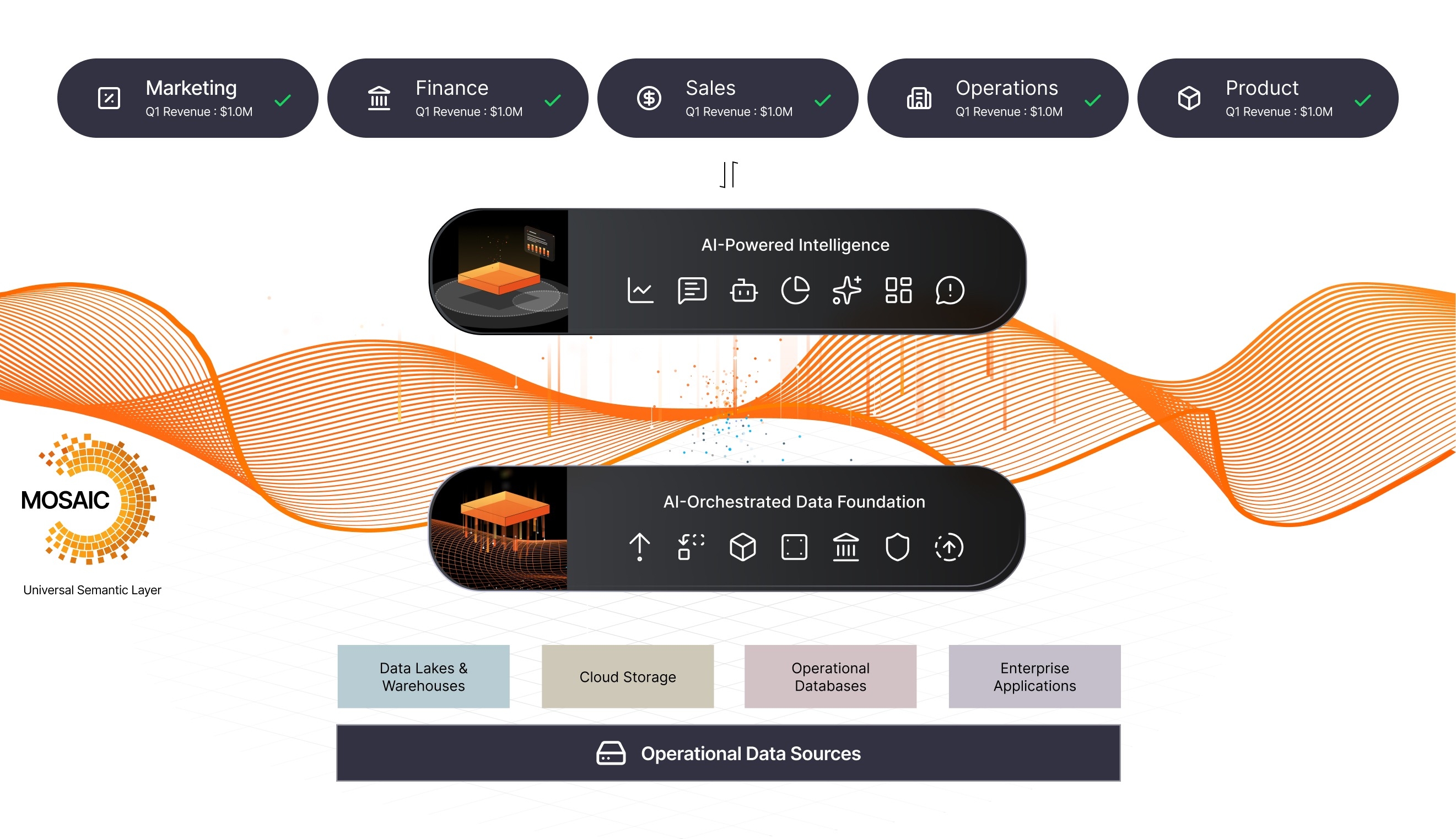
A semantic layer is that intelligence, made explicit and machine-readable.
But a static semantic layer that simply maps metric names to SQL formulas is not enough. That’s a dictionary. Agents need a brain.
The semantic layer has to evolve.
It needs ontology: A formal understanding of what the things in your business are and how they relate to each other.
It needs rules: the logic that governs how your business actually runs.
And it needs to learn: capturing usage patterns, personalizing to roles, and disambiguating terms based on who is asking and why. When those three things come together, you stop giving agents data and start giving them understanding. That is when agentic AI stops being a pilot and starts being infrastructure.
The independence problem nobody is talking about
There is a second issue that deserves more attention than it gets.
Many enterprises today are tempted to build their semantic context inside their data platforms, embedded within Snowflake, Databricks, or BigQuery.
It feels efficient. One fewer system to manage. But this is a strategic error that compounds quietly over time.
The moment your business context is embedded inside your cloud data warehouse, you have effectively outsourced your organizational intelligence to that vendor. You can’t easily change clouds. You can’t adopt a better database. You can’t integrate the next generation of AI models without rebuilding from scratch. Your semantic layer—the encoded understanding of how your business runs—becomes a hostage to your infrastructure choices.
The semantic layer should be the most portable, sovereign component in your entire data stack. It should sit independently between your data sources and every consumer of that data: your BI tools, your AI agents, your LLMs, your custom applications.
That independence is not a technical nicety. It is a strategic requirement. It is what gives you the freedom to adopt the best cloud, the best database, and the best AI technology at any point in time—without starting over.
The AI-powered enterprise needs a brain, not just a data lake
Every enterprise is now asking the same question: How do we move from AI experimentation to AI transformation? The answer is not a better model. It is not a faster data warehouse.
It is a semantic layer that evolves—one that encodes your business deeply enough that any AI, any agent, and any application can act on it with confidence.
Independent enough that it travels with your business, not your vendor. Intelligent enough that it learns, adapts, and reflects how your organization actually thinks and operates.
That is what Mosaic is built to be. Not a feature inside your data stack, but the foundation underneath it.
The enterprises that build this foundation now will be the ones that look back in five years and understand why their AI transformation actually worked, while others are still wondering why their agents keep getting the answers wrong.

Saurabh Abhyankar
Saurabh Abhyankar has been innovating in analytics for 20 years and holds patents in self-service analytics, the semantic graph, and HyperIntelligence. Since 2016, he has held product leadership roles at Strategy, including SVP of Product Management and Chief Product Officer.
Related posts
Discover the transformative power of abstraction in human progress and data engineering with Strategy Mosaic's universal semantic layer, enabling seamless insights and productivity breakthroughs.
Saurabh Abhyankar
March 9, 2026
Discover how nearly half of all queries bypass Snowflake or Databricks, saving costs and optimizing performance. Learn how intelligent query routing can transform your data strategy and maximize ROI.

Joe Bullis
March 6, 2026
Enterprise AI fails without a semantic layer that enforces shared business meaning. Discover how Strategy Mosaic delivers governed, accurate, production-ready AI.

Tanmay Ratanpal
February 18, 2026

Discover how Strategy Mosaic transforms the enterprise semantic layer for the AI era—eliminating metric drift, unifying siloed data, automating governance, and grounding AI analytics in a single trusted source of truth.
Tanmay Ratanpal
February 18, 2026