

Products
Solutions
Ecosystems
Resources
Partners
The Semantic Layer: Architecture, Components, and the Foundation for Trustworthy AI
Key Takeaways
- A semantic layer translates raw data into governed business definitions: defined once, applied consistently to every BI tool, AI agent, and application that queries your data.
- A data model describes what data exists. A semantic layer defines what data means and resolves that meaning identically for every consumer at query time.
- Without a semantic layer, AI analytics tools guess business logic from raw table names, resulting in inconsistent answers that contradict governed dashboards.
- The Reconciliation Tax is real: a 10-person data team spending 35% of their time on metric reconciliation costs $525,000+ per year before accounting for delayed decisions.
Every organization runs into this problem: Two teams use the same report to track a metric but get completely different answers.
Teams spend more time reconciling insights instead of acting on them, and numbers don’t match because the underlying datasets include different metric definitions.
For organizations that rely on AI-powered analytics, this means that the AI assistant models data instantly, but it can’t validate the answers because it doesn’t know what datasets to look at. The problem isn’t the dashboards, tools, or the AI itself. It’s the lack of a data foundation. And the fix is a semantic layer that unifies logic, governance, and data modeling.
What Is a Semantic Layer?
A semantic layer sits between your raw data and every system that consumes it: BI tools, AI assistants, notebooks, spreadsheets, and APIs. It acts as a unified business logic layer that translates technical data structures into governed business definitions, such as:
- what “revenue” means
- how “active users” are counted
- what qualifies as “churn”
These definitions are created once and applied consistently across the enterprise, ensuring every tool, user, and AI system works from the same understanding of your data.
What Does a Semantic Layer Do?
A semantic layer standardizes how data is defined, connected, and delivered across the enterprise. Instead of pushing logic into every downstream tool, it centralizes that logic and resolves it consistently at query time.
This shows up across several core areas:
Metrics and Metric Logic
Metrics carry more than a formula. A well-defined metric can include scoped filter logic, aggregation behavior, and calculation-level settings. In a semantic layer, that logic is defined once and reused consistently across dashboards, notebooks, applications, and AI-driven experiences.
Attributes and Hierarchies
Attributes are the axes of analysis: the who, what, where, and when applied to every metric. A semantic layer supports multi-form attributes, and hierarchies define how data rolls up or how users drill through it. The navigation logic lives in the semantic layer instead of being recreated in each downstream tool.
Joins and Relationship Handling
The semantic layer centralizes relationship logic, so consuming tools do not have to recreate joins manually. Downstream consumers request metrics and attributes; the semantic layer resolves the underlying relationship path.
Time Logic and Fiscal Calendars
A semantic layer can model business calendars, time-zone-aware analysis, and period comparisons explicitly, so definitions like “quarterly revenue” align with the governed business calendar instead of varying by tool or dashboard.
Security and Policy Enforcement
Row-level security, role-based access controls, and audit trails travel with the semantic layer. It combines governance and monitoring, so users see only the data they are authorized to access, regardless of which supported client initiates the query.
Caching, Pushdown, and Performance
A modern semantic layer combines pushdown processing, cross-source calculations, and caching to improve performance and reduce repeated warehouse work. As a result, analytics run faster while data remains in place.
A Data Model Is Not a Semantic Layer
This distinction matters more than most organizations realize, and it’s where a lot of data projects stall.
A data model describes the shape of your data. It can live inside dbt, a warehouse schema, or a BI tool’s modeling layer. It defines tables, columns, relationships, and sometimes transformations. It is genuinely useful, but there’s a caveat.
A data model tells consuming systems what data exists and how it relates. It doesn’t tell them what that data means or how it should be calculated.
That gap shows up in practice like this:
- A well-modeled dbt project defines a table called fct_revenue with clean joins and documented columns.
- When Tableau connects to that table, it calculates revenue one way.
- When Power BI connects to it, it calculates revenue in another way.
- When an AI agent queries it, it infers revenue based on the column names and schema documentation alone.
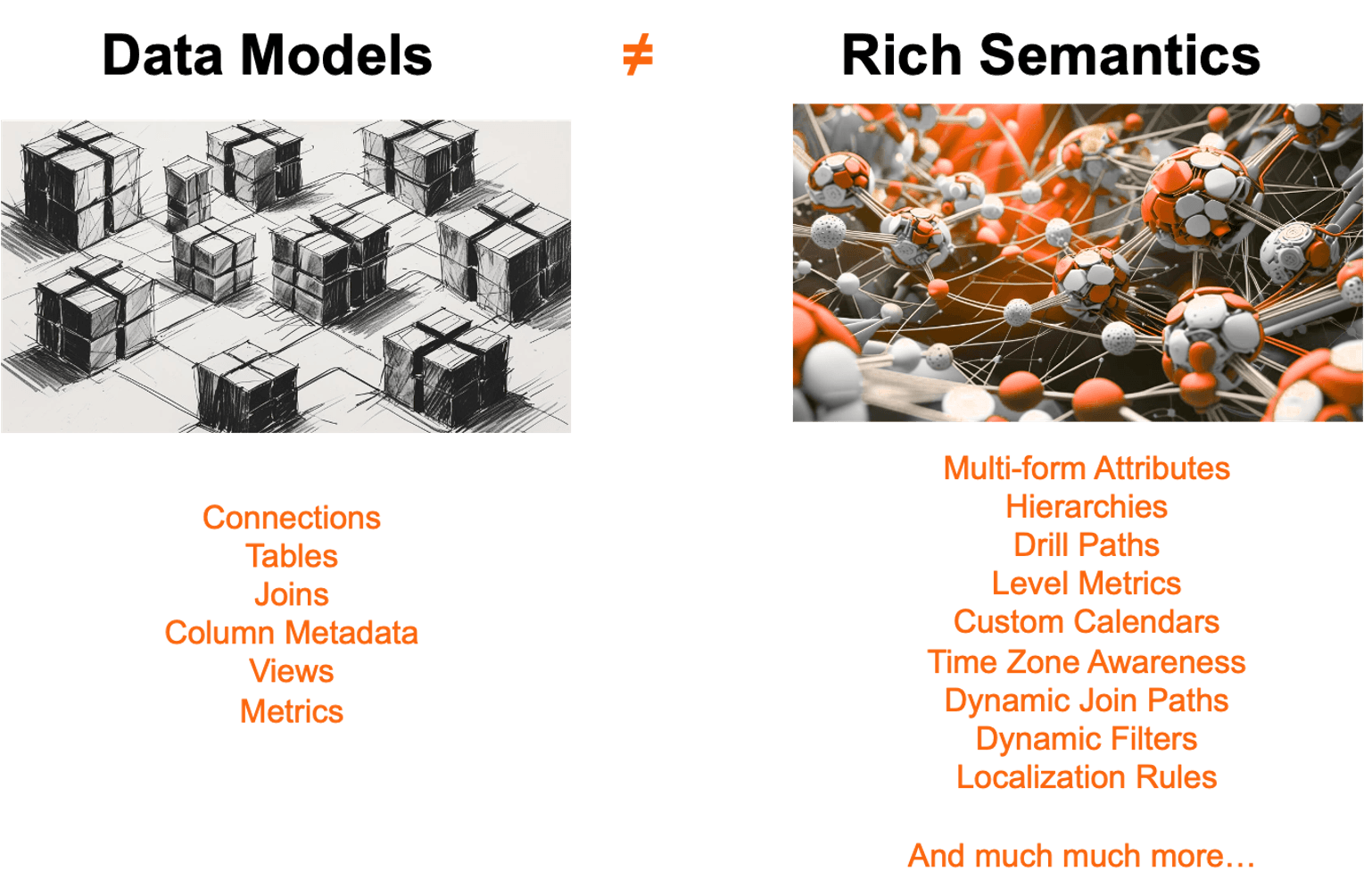
A Data Model Is Not a Semantic Layer
The result: the data is consistent, but the answers are not.
A data model structures data. A semantic layer defines business meaning.
It defines business concepts like “ARR Run-Rate", not as a column, but as a governed metric with its calculation logic, filters, fiscal calendar alignment, and access policies.
When any tool queries through the semantic layer, that definition is resolved centrally at query time. The answer is identical regardless of which system initiated the request.
Why the Semantic Layer Is No Longer Optional
For most of the last decade, metric inconsistency was painful but manageable.
Data teams reconciled numbers. Stakeholders learned which dashboards to trust. The system was inefficient, but it worked at human speed. Today, that model no longer holds.
As organizations adopt more BI tools, expand across data platforms, and introduce AI-driven analytics, the number of ways data can be interpreted has multiplied. Now, when a language model queries your data warehouse, it doesn’t know:
- Your business logic
- that “active users” excludes trial accounts
- that “net revenue” backs out refunds after 30 days
- that finance and marketing teams use different fiscal calendars
So it guesses. Confidently, at the speed and scale of every question being asked.
What used to be an operational inefficiency is now a systemic risk.
Every AI answer that contradicts the finance dashboard costs you a conversation, a re-run, and a little more stakeholder trust.
Without a semantic layer, there is no single system responsible for defining and enforcing business logic across the enterprise.
Why the Semantic Layer Matters for AI
At every major inflection point in data architecture, enterprises that invested in governing business logic at the semantic layer consistently outperformed those that didn’t.
AI is the next inflection point. And the stakes are higher than before.
When an AI assistant queries data incorrectly, it does so instantly, confidently, consistently, and at scale.
A language model querying raw tables has to infer business logic from table names and column descriptions. It has no awareness of your revenue definition, your user filters, or how your business actually defines its metrics.
So AI guesses, and it guesses each time differently.
For AI analytics to be trustworthy, the AI needs access to governed metric definitions:
- the same ones that power your dashboards
- the same ones approved by finance
- the same ones that match the board deck
Without that layer of governance, AI doesn’t produce insight. It produces variation.
Why Old Approaches to the Semantic Layer Failed
Every generation of the data stack has attempted to solve this problem in its own way. Each approach improved something, but none solved consistency at scale.
Approach 1: Tool-Embedded Semantics (The Fragmentation Pattern)
Each BI tool manages its own semantic definitions. This works until you have more than one tool.
As soon as organizations adopt multiple BI platforms, definitions begin to drift.
The same metric returns different numbers across tools. Governance becomes fragmented because there is no single layer to enforce it.
AI systems don’t resolve fragmentation. They inherit it.
Approach 2: Transformation-Layer Semantics (The dbt Pattern)
Business logic gets encoded in transformation models. Logic lives in version-controlled code. Definitions become more structured and repeatable.
But transformations produce tables, not governed metric definitions.
Different BI tools can still interpret the same table differently. AI systems querying those tables still lack access to the business meaning behind the data.
The result is cleaner data, but still inconsistent answers.
Approach 3: Purpose-Built, Independent Semantic Layer (The Modern Pattern)
Metric definitions live in a dedicated semantic layer that every downstream system queries through.
Logic is defined once, as a business concept, and applied consistently across tools, applications, and AI systems.
This is the first approach designed to enforce consistency at the level where meaning is defined, not where data is stored or consumed.
What a Next-Generation Enterprise Semantic Layer Should Look Like
A next-generation semantic layer is no longer just a place to standardize metrics for dashboards. It must serve dashboards, notebooks, APIs, applications, copilots, and AI agents with a consistent understanding of business logic.
In practice, this is what that looks like:
Example: Net Revenue
A well-defined “Net Revenue” metric in a semantic layer acts as a governed object that carries all the following in one place:
- Formula and filter logic: Sum of transaction amounts, net of refunds processed within 30 days, excluding internal test accounts
- Hierarchy behavior: Rolls up from transaction to product line to region to company, with consistent drill paths across every tool
- Fiscal calendar: Q3 refers to the company’s fiscal Q3 (October–December), not the calendar quarter
- Security policy: EMEA analysts see EMEA revenue. Finance sees globally. The row-level filter is enforced at query time by the semantic layer, not by each consuming tool independently
- Reuse: The same definition powers a Tableau dashboard, a Python notebook, an Excel report, and an AI agent response, all returning the same number
AI-Ready, Not AI-Approximate
The semantic layer should provide trusted business context at query time, not force AI systems to infer meaning from raw tables.
That means governed definitions, semantic disambiguation, prompt-level context, and open access through MCP-compatible workflows. AI should operate on business meaning, not schema guesswork.
Open and Portable by Design
A modern semantic layer cannot lock logic inside one warehouse, one BI tool, or one proprietary modeling framework. Semantic definitions should be reusable across environments and accessible through open interfaces and standards-based protocols.
Portability matters because enterprise stacks change. Business logic should not have to be rebuilt every time the platform does.
Operated Like Software
At enterprise scale, semantic logic is production logic. It needs a real lifecycle that includes authoring, versioning, review, testing, promotion, rollback, and auditability.
A semantic layer should be managed with the same rigor as software and data systems, not edited ad hoc inside downstream dashboards or reports.
In practice, that means model definitions stored as YAML in Git, promoted through dev-test-prod via version-controlled branches, with pull request review before any change reaches production and one-click rollback when something needs to be reversed.
Federated Across Platforms and Sources
The average enterprise runs across five or more data platforms. They operate across multiple clouds, warehouses, BI tools, applications, and increasingly, unstructured sources.
The semantic layer should sit above that complexity and federate meaning across systems rather than assume everything will be centralized into one stack.
A Control Plane for Trust, Governance, and Cost
A next-generation semantic layer should provide runtime policy enforcement, observability, auditability, performance intelligence, and cost awareness.
In the AI era, the semantic layer is not just a consistency layer. It is part of the control plane that makes enterprise analytics and AI reliable.
35 Years of Semantic Layer Innovation
The semantic layer isn’t a new idea. Founded in 1989, Strategy, then MicroStrategy, was among the first companies to architect the layer between raw data and business meaning.
We shipped one of the first enterprise semantic layers for large-scale production deployments when most modern data tools didn’t exist.
That work has continued across every major shift in data architecture:
1989 | Founded |
Early 1990s | Bulk Reporting |
Late 1990s | Semantic Layer |
2000s | Web + Self-Service Dashboards |
2010s | Mobile BI + Embed SDK |
2015+ | HyperIntelligence + Cloud Native |
2020s | AI Agents |
2025 | Mosaic |
When we say we understand the semantic layer, we mean we’ve run it in production for the world’s largest enterprises across multiple data architecture eras, for over three decades.
Strategy Mosaic is not our first semantic layer.
It is the latest evolution of that work, built for the needs of the modern enterprise.
What Are the Capabilities of a Modern Semantic Layer?
A modern semantic layer is defined by a set of core capabilities that determine whether it can scale across tools, teams, and AI-driven workflows.
Strategy Mosaic is built on these principles, refined over decades of enterprise deployments, to provide a semantic layer that serves as a durable foundation, not just another data project.
01. Rich Semantics + Business DefinitionsDefine every metric, attribute, and business concept in one governed place. Mosaic translates raw data structures into the language your organization actually uses, ensuring revenue means the same thing in every dashboard, AI query, and report. | 02. Optimized Universal AccessMosaic connects to 200+ data sources and serves the same governed metric and attribute definitions to any consumer (Tableau, Power BI, Excel, Python, AI agents, custom apps) via open interfaces (JDBC, XMLA, DAX, REST SQL). It resolves business logic, filters, joins, and security at query time, ensuring consistent results without locking you into proprietary interfaces. |
03. In-Memory Processing + VirtualizationMosaic’s Query Acceleration Engine uses intelligent caching, pushdown processing, and cross-source computation to deliver fast query performance without copying data. Analytics run at speed, on data that stays where it lives. | 04. Governance + Single Pane of GlassMosaic Sentinel provides unified governance intelligence across your entire semantic layer, including audit trails, access control, usage visibility, and real-time monitoring. This ensures that governance is enforced consistently across all tools and users. |
05. AI-Powered ModelingMosaic Studio accelerates semantic model development with AI-assisted workflows. Both technical and non-technical users can define and extend models, while AI systems consume governed definitions directly for reliable analytics. | 06. Portable + IndependentMosaic is vendor-agnostic by design. It integrates with existing infrastructure, supports multiple BI and AI tools, and eliminates the need to rebuild business logic when your stack evolves. |
Modern vs. Traditional Semantic Layer
The gap between traditional and modern semantic layers comes down to how consistently they define and enforce business logic.
| Traditional | Modern (Strategy Mosaic) |
Where semantics live | Inside individual BI tools | Platform-native, tool-agnostic semantic layer |
Who can access them | BI users only | BI tools, AI agents, APIs, notebooks, and applications |
Maintenance | Managed per tool, often manually | Centralized, version-controlled, and managed by data teams |
Governance | Siloed across platforms | Unified governance with centralized policy enforcement |
AI compatibility | Not accessible to AI systems | Natively accessible to AI agents and copilots |
Consistency | Definitions drift over time across tools | Consistent by design, enforced at across the enterprise |
Scalability | Breaks as tools and teams grow | Scales across tools, teams, and data platforms |
Architecture | Tool-bound and fragmented | Vendor-agnostic and composable across systems |
Operational model | Managed inside dashboards and reports | Operated like a production system with lifecycle control |
Performance | Repeated queries increase warehouse load | Intelligent caching, pushdown, and query acceleration |
Time to value | Slow and dependent on tool configuration | Faster deployment with reusable definitions |
How a Modern Semantic Layer is Managed in Production
A semantic layer is not just modeled. It is operated as a production system.
Semantic definitions are production logic with downstream dependencies, and they must be managed with the same rigor as software.
01. Author Define metrics, dimensions, and relationships in Mosaic Studio or via YAML. Non-technical users work through the visual interface; developers work through code. | 02. Review + Impact Analysis Before publishing, validate which dashboards, agents, notebooks, and applications depend on the logic being changed. Catch downstream effects before they reach production. |
03. Version Track semantic changes in Git. Every definition is versioned, diffable, and attributable—with full commit history and branch support for isolated development. | 04. Test Run validation in dev or staging before promoting. Changes move through a controlled workflow rather than being applied directly to live logic. |
05. Promote Move releases from dev to test to prod through a repeatable, auditable promotion path. No manual rebuilding across consuming tools. | 06. Monitor + Rollback Mosaic Sentinel provides real-time alerts, audit trails, and usage insights. If a definition causes downstream issues, prior versions are restorable without rebuilding logic from scratch. |
This is the difference between a semantic layer built for experimentation and one built for enterprise-scale operations.
Benefits of a Purpose-Built Semantic Layer
A purpose-built semantic layer doesn’t just improve how data is modeled. It changes how organizations operate.
Consistent Numbers, Every Time
No more reconciliation meetings. No more “which dashboard is right?”
Metrics are defined once and enforced at query time, so every tool, team, and AI system returns the same answer.
More Analysis, Less Arbitration
Without a semantic layer, data teams spend a significant portion of their time explaining why numbers don’t match. Organizations that implement a governed semantic layer reduce time spent on reconciliation and shift focus back to analysis and decision-making.
Here's an example: a ten-person data team averaging $150K fully loaded, spending 35% of their time on metric reconciliation, costs $525,000 a year. That’s before accounting for delayed decisions, analyst attrition, or AI projects that stall because underlying metrics aren’t reliable.
Stakeholders Who Actually Trust the Data
Trust breaks when numbers don’t match. It rebuilds when they do. A semantic layer ensures that every report, dashboard, and AI output is grounded in the same definitions, restoring confidence across the organization.
An AI Stack You Can Actually Trust
AI systems that query raw tables produce inconsistent results at scale. A semantic layer ensures that AI operates on governed definitions, so every answer aligns with the same logic used across dashboards and reports.
Cloud Cost Control: Stop Paying to Answer the Same Question Twice
Every query against your warehouse costs money.
Mosaic’s in-memory engine caches results intelligently, so repeat queries — the same revenue figure pulled by ten different people across ten different tools — are served from memory, not re-executed against your cloud warehouse.
It reduces redundant queries, ensuring that the same question is not recomputed across multiple tools and users.
Measured Impact
UserEvidence 2026 ROI Study — across Strategy customers in retail, telecom, and financial services:
$3.4Mavg net annual impact | 551%ROI, 2-month payback | 46%analyst time reclaimed | 44%fewer redundant metrics | 9 / 10metric confidence (up from 5) |
Conclusion
The semantic layer is not a new concept. What’s changed is the cost of operating without one.
AI analytics has raised the stakes for metric consistency beyond what manual processes can manage. When every user can ask a data question and get an instant answer, the quality of your metric definitions is exposed at a scale and speed that only a governed semantic layer can support.
We’ve been building that layer since 1989, and we’ve seen every data architecture era, every inflection point, and every failure mode. Strategy Mosaic is what 35 years of that experience looks like when the stakes finally match the problem.
Strategy Mosaic is the enterprise-grade semantic layer that centralizes, governs, and defines metrics once, so your teams, tools, and AI operate on consistent, trusted business logic.

Lauren O’Connor
Lauren crafts compelling product stories that resonate with users. With a passion for understanding customer needs, she transforms technology into intuitive solutions that empower organizations to thrive in a digital landscape.
Content:
- What Is a Semantic Layer?
- What Does a Semantic Layer Do?
- A Data Model Is Not a Semantic Layer
- Why the Semantic Layer Is No Longer Optional
- Why the Semantic Layer Matters for AI
- Why Old Approaches to the Semantic Layer Failed
- What a Next-Generation Enterprise Semantic Layer Should Look Like
- 35 Years of Semantic Layer Innovation
- What Are the Capabilities of a Modern Semantic Layer?
- Modern vs. Traditional Semantic Layer
- How a Modern Semantic Layer is Managed in Production
- Benefits of a Purpose-Built Semantic Layer
- Conclusion
Related posts

Discover Strategy Mosaic—the AI-powered Universal Intelligence Layer that unifies your data ecosystem. Eliminate silos, enforce governance, and deliver consistent, trusted insights across every BI tool. Future-proof your data strategy and accelerate AI adoption with Mosaic.
Lauren O’Connor
July 30, 2025

Discover how a Universal Intelligence Layer ensures governed data, consistent KPIs, and AI-ready analytics across the enterprise.

Tanmay Ratanpal
July 9, 2025