

Products
Solutions
Ecosystems
Resources
Partners
Strategy World 2026 is coming. Join us February 23–26, 2026. Register now →
Software Bloat Is Quietly Destroying Data Efficiency in Enterprise Analytics
Software bloat rarely starts as a visible problem. In enterprise analytics environments, it builds quietly through redundant queries, overlapping pipelines, duplicated logic, and unnecessary compute that accumulates across the data stack.
Consumption-based pricing accelerates this problem. It’s sold as the ultimate dream: pay only for what you use, avoid upfront licenses, and scale without friction. In reality, it often proves far more costly for an organization’s data efficiency, analytics costs, and long-term growth.
Why Vendor Pricing Models Matter More Than You Think
Imagine this: you’re scaling your data infrastructure and need a BI platform that can support your existing ecosystem without adding unnecessary complexity or cost. To build a long-term data strategy, you evaluate both a vendor’s technical architecture and its business model.
If that model is consumption-based, it’s worth looking deeper into the potential risks.
In theory, consumption pricing charges customers only for what they use, based on metrics like storage, API calls, or compute time. In practice, this is where enterprise software bloat becomes profitable for vendors.
This is no coincidence. Many BI platforms and cloud data warehouses that rely on pay-as-you-go pricing models cannot and will not handle software bloat effectively.
Simply put: doing so would undermine their revenue model.
How Software Bloat Inflates Analytics Costs Over Time
Vendors often rely on unpredictability to inflate consumption-based prices. That unpredictability is sustained through choices such as:
Default Timeouts: Query timeouts are often set to 48 hours. A one-hour timeout would protect users, but a 48-hour runaway query ensures you pay for every minute it runs. One poorly written query can quietly burn compute for days.
Infrastructure Abstraction: By hiding servers, CPUs, and memory behind simplified interfaces, platforms make it easy to forget that every SQL command triggers multiple cost vectors. Leaders lose visibility into which teams, dashboards, or workloads are driving spend, and the system keeps leaking money.
Arbitrary Scaling: Teams are encouraged to upsize warehouses “for speed.” Moving from Medium to Large can instantly double costs without delivering proportional performance gains. Performance problems get solved by spending instead of understanding.
Unpredictability isn’t a flaw in these systems. It’s the hidden mechanism that weakens your data layer’s structure.
The Three Structural Causes of Software Bloat in the Data Layer
Software bloat in the data layer typically stems from three architectural failures:
Query Sprawl: When BI tools or unmanaged users fire off redundant, unoptimized queries, warehouses spin up repeatedly to answer the same question. Without intelligent caching, ten dashboard refreshes mean ten full compute cycles instead of one.
The Zombie Pipeline: Scheduled ETL jobs that no longer serve a purpose but continue to run. The dashboard was deprecated, the team moved on, but the pipeline lives. Because jobs succeed in logs, they silently drain budgets.
Inefficient Data Movement: Many teams pull data out of warehouses into separate application memory for processing. This is the opposite of a query pushdown. Logic runs in the least efficient layer, inflating compute costs unnecessarily.
The Long-Term Business Costs of Unchecked Software Bloat
At scale, software bloat becomes a strategic risk that affects budgeting, planning, and long-term data governance decisions. If left unaddressed, it creates risks that extend far beyond a single monthly bill.
Factor | Long Term Strategic Risk | Business Impact |
Query Sprawl | Unpredictable budget volatility | CFO friction and frozen technical roadmaps |
Zombie Pipelines | Cumulative technical debt | Engineering time wasted on maintenance |
Inefficient Movement | Vendor lock-in and high “exit taxes” | Reduced agility to migrate to cheaper storage |
How a Universal Semantic Layer Tackles Software Bloat
Strategy Mosaic is a universal semantic layer designed to sit independently between your data sources and your users. Beyond unifying definitions and business logic, it also functions as a compute optimization and arbitrage layer.
By centralizing business logic and query execution, a universal semantic layer directly limits redundant compute, query sprawl, and unnecessary data movement.
Instead of letting every user query hit an expensive cloud warehouse directly, Mosaic evaluates each request and determines the most cost-effective execution path.
1. Fixed Cost Caching
Mosaic’s pricing is user-based, not consumption-based. When the first user opens a dashboard, Mosaic fetches and caches the data. When the next 49 users open that same dashboard, the query hits Mosaic’s memory, not your warehouse. Variable and unpredictable spend is replaced with a fixed cost model.
2. Intelligent Query Pushdown
In traditional architectures, joining data from platforms like Databricks and SQL databases often requires egressing data into a third system, incurring both compute and transfer costs.
Mosaic analyzes each query and pushes execution to the cheapest and most efficient option available. You pay compute costs only where it’s necessary, and only for the slice of data that needs it.
3. Deep Usage Intelligence
Through Mosaic Sentinel, the platform tracks which semantic models and objects are actually being used. If a complex transformation runs hourly but hasn’t been queried in 30 days, Sentinel flags it. You can kill the pipeline immediately and stop zombie spending at the source.
Why Vendor-Agnostic Architecture Matters for Reducing Software Bloat
Cloud vendors rely on lock-in through proprietary formats and tightly coupled logic. When business logic is tightly coupled to a single platform, software bloat becomes harder and more expensive to unwind over time.
Strategy Mosaic is vendor-agnostic. It decouples your business logic (how you define "Revenue" or "Churn") from the underlying database.
If the provider raises prices, a vendor-agnostic semantic layer allows you to migrate to a cheaper alternative without re-architecting models or breaking dashboards. Your BI tools and downstream applications remain connected to centralized logic, not vendor-specific infrastructure.
Tackle Software Bloat with Strategy Mosaic
Cloud data platforms aren’t designed to control software bloat. They monetize it. Strategy Mosaic addresses the problem at the architectural level by enforcing one semantic layer and one source of truth.
The result: More focus on insights. Less money is spent on invisible infrastructure costs.
You keep the benefits of your existing data platforms, without letting them dictate your spending.
See how Strategy Mosaic’s vendor-agnostic architecture works.

David Peterson
David is a Management Associate at Strategy where he currently works on Field Enablement and Demand Generation. David recently graduated from the University of Virginia where he studied Economics and Music and performed Improv Comedy.
Content:
- Why Vendor Pricing Models Matter More Than You Think
- How Software Bloat Inflates Analytics Costs Over Time
- The Three Structural Causes of Software Bloat in the Data Layer
- The Long-Term Business Costs of Unchecked Software Bloat
- How a Universal Semantic Layer Tackles Software Bloat
- Why Vendor-Agnostic Architecture Matters for Reducing Software Bloat
- Tackle Software Bloat with Strategy Mosaic
Related posts
Discover how goeasy, a leading Canadian non-prime consumer lender, transformed its data strategy into a strategic asset by leveraging a universal semantic layer. Learn from Jide Adeoye, Director of Business Intelligence, about their journey from legacy reporting to agentic AI and the impact of Strategy Mosaic on their data-driven success.
.png&w=750&q=75)
The Strategy Team
February 2, 2026
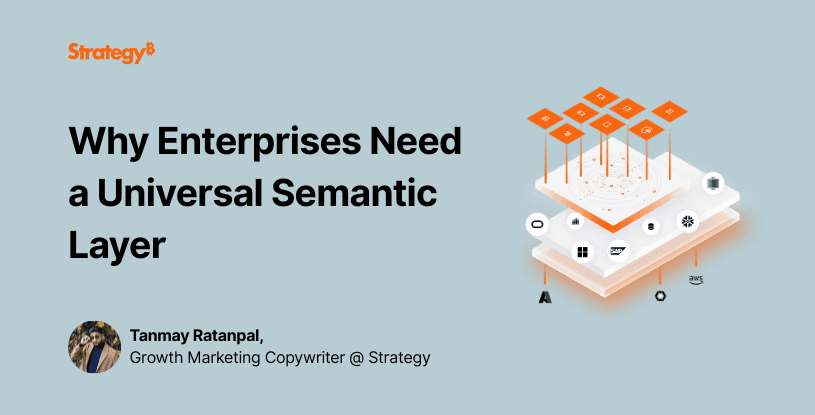
Discover why enterprises need a universal semantic layer to transform data into actionable insights. Mosaic, the next-generation semantic layer, offers consistent, real-time data access, enhancing decision-making and operational efficiency in the AI era.

Tanmay Ratanpal
June 18, 2025
Vendor lock-in quietly erodes data value. Learn why independence at the semantic layer is critical to avoid rigid stacks and future-proof analytics and AI strategies.
David Peterson
January 19, 2026