

Products
Solutions
Ecosystems
Resources
Partners
5 Ways Strategy Mosaic Redefines the AI-Ready Enterprise Semantic Layer
Enterprise analytics has entered a new era: AI systems and analysts are now querying business data side-by-side, executives are expecting real-time alignment across teams, and organizations are operating across dozens of tools, warehouses, and applications.
In this environment, a traditional semantic layer is no longer enough. Organizations need an AI-ready enterprise semantic layer that ensures both humans and AI systems operate from the same defined business logic.
What is an Enterprise Semantic Layer?
A semantic layer acts as a universal translator that standardizes metrics, aligns context, and unifies reporting. It centralizes data logic, so each team speaks the same language across tools, apps, and BI environments.
At the enterprise level, this layer becomes the abstraction point between raw data systems and business decision-making, ensuring that metrics, definitions, and relationships are defined once and reused across every workflow.
Strategy Mosaic takes that foundation and turns it into a single, governed, AI-powered command center that powers all enterprise analytics.
Why Legacy Semantic Layers Break in the AI Era
Traditional semantic layers were built for dashboards, not AI agents. They are often:
Tool-locked to a single BI environment
Dependent on manual metric modeling
Fragmented across departments
Disconnected from enterprise-wide governance
Lacking the rich metadata required to ground AI systems
The shift to AI-driven analytics has exposed the limits of legacy BI setups. Tool-specific modeling layers that worked for dashboards do not scale across teams, systems, and AI agents. The result is fragmented analytics, inconsistent KPIs, and AI systems that operate without reliable context.
Organizations need a unified semantic foundation that connects everything together.
That’s what Strategy Mosaic is built for.
1. Strategy Mosaic Eliminates Metric Drift Across the Enterprise
Metric drift occurs when the numbers used to analyze performance stop meaning what they once did because the context changed, even if the underlying systems did not.
Imagine your Marketing, Finance, and Legal teams want to track "Gross Margin" for the last quarter. They put in the request and wait for their BI tool to respond.
Marketing sees $40K. Finance sees $45K. Legal sees $47K. The calculations are correct, but the metrics differ.
The problem lies in the lack of metric reconciliation. Even if they use the same tools for analytics, the results vary because their data source defines "Gross Margin" differently.
The Mosaic Advantage: Strategy Mosaic provides a Universal Semantic Layer where definitions are only created once. If Finance updates a single definition, that change instantly propagates to every other connected tool like Power BI, Tableau, or Excel sheets.
This allows teams to view, analyze, and act on consistent logic every single time.
2. Strategy Mosaic Automates the "Translation" of Raw Data
Traditionally, when a business user needs a new insight, they have to "order" it from IT. A data engineer then spends days manually mapping technical column names into business logic using tools like dbt or Looker.
This creates a massive backlog. By the time the data is ready, the opportunity to act on it has often passed. In large enterprises, this dependency compounds across departments, creating bottlenecks that slow analytics initiatives and delay AI adoption.
The Mosaic Advantage: With Mosaic Studio, the platform leverages AI-powered modeling to automatically detect relationships and suggest business-friendly names. It effectively translates technical data into human language 10x faster than manual coding. In enterprise environments, this can reduce semantic modeling timelines from weeks to hours.
Instead of manually stitching logic across systems, organizations build a reusable semantic foundation that supports both analytics workflows and AI-driven queries.
3. Strategy Mosaic Unifies Disparate Data Silos
Departments often prefer certain workflows over others. Whether it’s Salesforce for CRM, SAP for ERP, or Snowflake for the warehouse, these platforms tend to store, define, and contextualize data differently. Traditional semantic layers struggle to join these data sources without massive ETL projects that cost time, money, and valuable resources.
As enterprises expand their technology stacks, this fragmentation becomes exponential, not incremental.
The Mosaic Advantage: Strategy Mosaic connects to over 200 disparate data sources and unifies them into a single, governed source of truth. Its vendor-agnostic, portable architecture means you can simply plug and play it across workflows without costly overhauls. Business users see a direct correlation between departments, analysts drill down with greater accuracy, and engineers don’t spend hours building new data pipelines.
This is what turns a semantic layer into an AI-ready enterprise semantic layer: the ability to connect systems, move across workflows, and centralize business logic in one place.
Helsana, Switzerland’s largest health and accident insurer, faced the challenges of an overloaded legacy BI setup: data scattered across multiple warehouses, locked datasets in siloed systems, and inconsistent reporting tools.

See how Helsana partnered with Strategy to modernize its data analytics stack and reduce reports by 90%.
4. Strategy Mosaic Powers Hallucination-Free AI
Generative AI is only as smart as the data it’s fed. Without governed logic and centralized context, AI guesses what your data means. This causes AI to hallucinate, generating false, inaccurate, or nonsensical responses. When replicated across teams, these errors compound into larger alignment and governance issues.
The Mosaic Advantage: Mosaic acts as a single source of truth for AI agents. Because it provides rich metadata and centralizes definitions, any AI tool querying your datasets via Mosaic is bound to your specific business logic. Rather than interpreting raw tables, AI systems operate against curated semantic models that reflect approved business definitions.
This eliminates AI hallucinations and ensures outputs remain aligned with approved business definitions. By grounding AI queries in centralized metadata, organizations reduce the risk of inconsistent or non-compliant responses.
5. Strategy Mosaic Centralizes Enterprise Governance
Business users shouldn't have to worry about data privacy laws, but the business must. Sensitive data drives operations, and its protection must be a priority. One misconfigured access point can lead to legal and reputational damage.
Governance at the dashboard level isn't enough once AI systems begin querying enterprise data.
The Mosaic Advantage: Mosaic centralizes security at the foundational level. You can set row-level and column-level security once (e.g., restricting managers to only view their own team’s salaries) and automatically enforce it across every connected application. As governance is embedded directly into the enterprise semantic layer, policies travel with the data across BI tools, analytics platforms, or AI systems.
This ensures that the right people see the right data, regardless of the workflow they use.
Traditional vs AI-Ready Enterprise Semantic Layer
Capability | Traditional Semantic Layer | AI-Ready Enterprise Semantic Layer |
Metric Definitions | Often duplicated across tools | Defined once, deployed everywhere |
Tool Compatibility | Locked to specific BI platforms | Vendor-agnostic across tools and workflows |
AI Support | Limited metadata context | AI-grounded, hallucination-resistant |
Governance | Tool-level enforcement | Centralized semantic-layer enforcement |
Enterprise Scale | Fragmented across departments | Unified enterprise-wide business logic |
An AI-ready enterprise semantic layer isn't just an advantage. It’s the foundation that keeps analytics consistent, AI outputs reliable, and teams working from the same logic.
How Strategy Mosaic Turns Data into a Strategic Advantage
Ultimately, an enterprise semantic layer isn't measured by how well it handles SQL, but by how effectively it empowers your organization. When the data layer is fragmented, insights are locked within silos, and teams remain divided.
Strategy Mosaic goes beyond traditional semantic modeling by providing a universal data foundation that bridges raw data systems and executive decision-making.
It Reclaims Time: Strategy Mosaic eliminates redundant queries and manual reconciliation by allowing teams to define metrics in hours instead of weeks.
It Guarantees Truth: With its "define once, deploy everywhere" architecture, Mosaic ensures that every department is working from the same logic, even within their preferred tools.
It Future Proofs Your AI: By providing a governed, contextually aligned semantic foundation, Mosaic ensures that investments in generative AI yield accurate, enterprise-trusted insights.
Explore The Future of Enterprise-Ready Analytics
Organizations today operate across more data systems than ever before. With countless teams, tools, and applications, they need a foundation that does more than unify data.
They need one that standardizes logic, embeds governance, and scales with AI.
Strategy Mosaic delivers an AI-ready enterprise semantic layer that turns fragmented data into consistent, governed insights that both people and AI systems trust.
Discover how Strategy Mosaic’s universal semantic layer powers consistent, secure, and trusted metrics across every workflow.

Tanmay Ratanpal
A copywriter and brand strategist with 8+ years of experience turning ideas into compelling content. He blends sharp messaging with smart storytelling to build brands that connect, spark conversations, and (mostly) win your boss’s approval.
Content:
- What is an Enterprise Semantic Layer?
- Why Legacy Semantic Layers Break in the AI Era
- 1. Strategy Mosaic Eliminates Metric Drift Across the Enterprise
- 2. Strategy Mosaic Automates the "Translation" of Raw Data
- 3. Strategy Mosaic Unifies Disparate Data Silos
- 4. Strategy Mosaic Powers Hallucination-Free AI
- 5. Strategy Mosaic Centralizes Enterprise Governance
- Traditional vs AI-Ready Enterprise Semantic Layer
- How Strategy Mosaic Turns Data into a Strategic Advantage
- Explore The Future of Enterprise-Ready Analytics
Related posts
Enterprise AI fails without a semantic layer that enforces shared business meaning. Discover how Strategy Mosaic delivers governed, accurate, production-ready AI.
Tanmay Ratanpal
February 18, 2026

Semantic data modeling is the missing foundation for enterprise AI. Learn how a universal semantic layer and semantic model automation unify business logic, prevent KPI drift, and deliver trusted, consistent AI and analytics across every team and tool with Strategy Mosaic.
Tanmay Ratanpal
February 13, 2026
Discover how goeasy, a leading Canadian non-prime consumer lender, transformed its data strategy into a strategic asset by leveraging a universal semantic layer. Learn from Jide Adeoye, Director of Business Intelligence, about their journey from legacy reporting to agentic AI and the impact of Strategy Mosaic on their data-driven success.
.png&w=750&q=75)
The Strategy Team
February 2, 2026
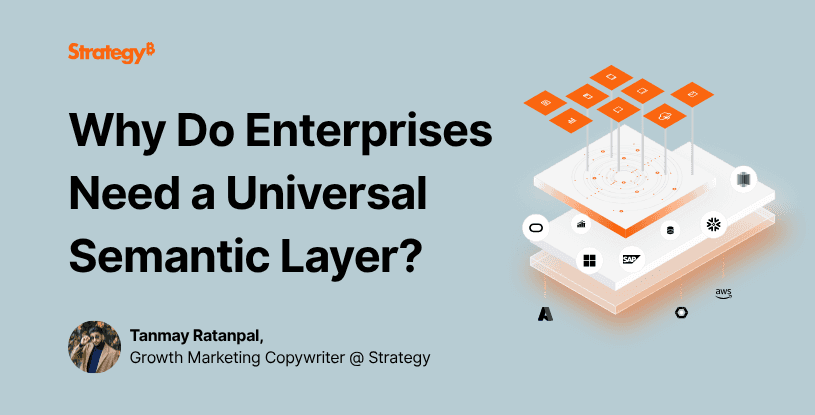
Discover why enterprises need a universal semantic layer to transform data into actionable insights. Mosaic, the next-generation semantic layer, offers consistent, real-time data access, enhancing decision-making and operational efficiency in the AI era.
Tanmay Ratanpal
June 18, 2025
Vendor lock-in quietly erodes data value. Learn why independence at the semantic layer is critical to avoid rigid stacks and future-proof analytics and AI strategies.

David Peterson
January 19, 2026