

Products
Solutions
Ecosystems
Resources
Partners
Why AI Agent Governance Fails: 69% of Organizations Lack Agent-Ready Policies
AI agent governance is a critical challenge for most organizations, and more than half has already experienced incidents from poor governance. Traditional oversight fails for autonomous AI and the AI governance gap is the culprit.
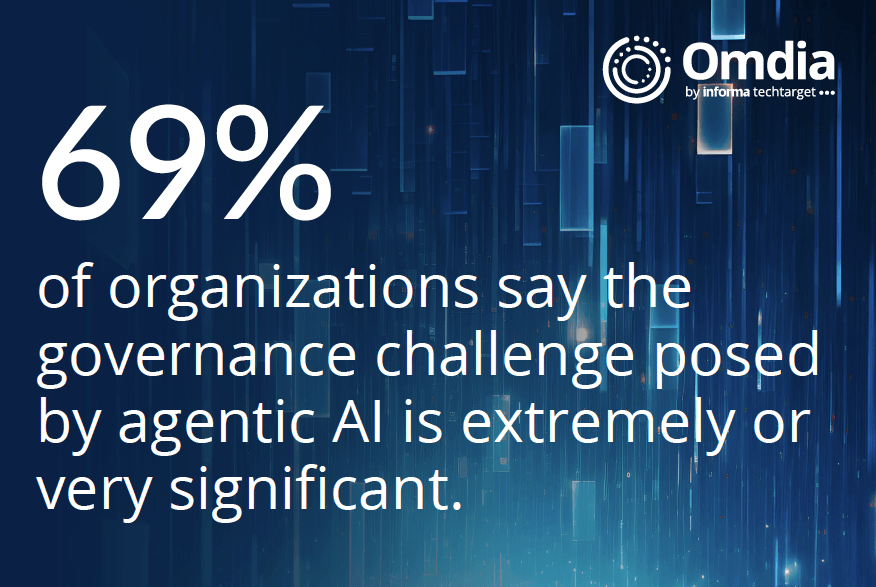
The average data breach now costs U.S. organizations $9.36 million, and that figure continues to climb as enterprises accelerate AI deployment. But a new warning signal has emerged from Omdia research surveying 400 IT and data professionals: 69% of organizations say the governance challenge posed by agentic AI is extremely or very significant, and most are using governance practices designed for human decision-making, not autonomous AI agents operating at machine speed.
What is Agentic AI Governance?
Agentic AI governance is the framework of policies, controls, and monitoring systems that ensure AI agents operate safely, transparently, and in compliance with regulations when they access and act on enterprise data autonomously. Unlike traditional governance, which relies on periodic audits and human oversight, agentic AI governance must operate continuously at machine speed to prevent autonomous agents from cascading data quality issues or security exposures across systems before detection.
Every autonomous agent has machine-speed access to enterprise data assets, but a single flaw in data lineage or quality triggers untraceable, cascading risk events as agents act on compromised information. This fragmented governance creates new C-suite blind spots that threaten business success, and organizations need fundamentally different governance architectures to manage AI that operates beyond human oversight cycles.
The Scale of the Governance Gap
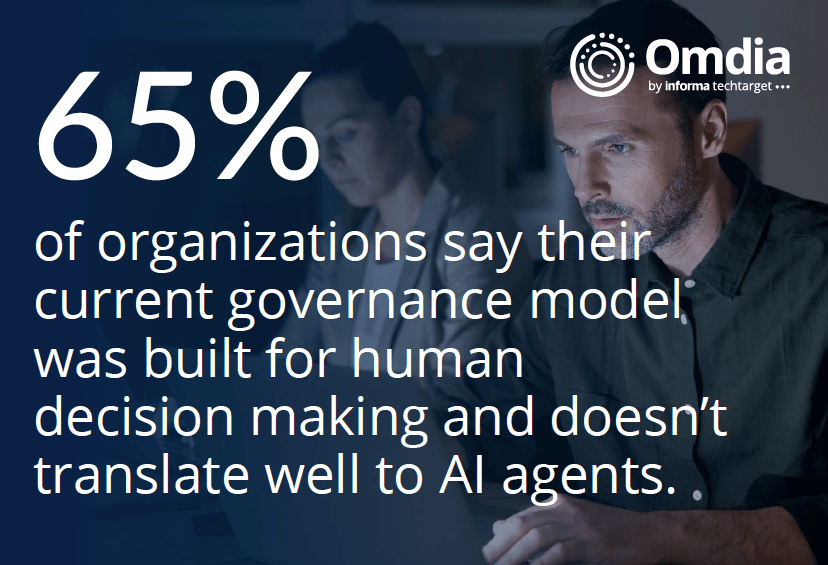
The numbers tell a sobering story. According to the new Omdia study, nearly two-thirds of organizations (65%) say their current governance model was built for human decision-making and doesn’t translate well to AI agents.
These aren’t abstract concerns. As many as 71% of organizations express concern about AI-related security and compliance incidents, and for good reason: most of them (56%) have already experienced negative consequences, either material or requiring remediation, from poor AI governance.
“These are not theoretical risks being evaluated in planning documents; they are live concerns being managed by people who are already running AI in production.”
— Mastering Governed Autonomy: From Policy Blind Spots to Competitive Edge, Omdia, May 2026
Why Agent Failures Are Different
Unlike human errors that surface through review processes and organizational checks, agent errors propagate silently across systems at scale before detection. The velocity and autonomy that make agents valuable also make data governance failures exponentially more damaging, transforming minor data quality issues into enterprise-wide incidents that erode customer trust, regulatory standing, and competitive position.
Consider a typical scenario: Your marketing team analyzes customer behavior through one platform. Your finance team queries the same customer data through another. Your AI agent pulls from both sources to generate insights. Each tool has different definitions of “customer,” different access controls, and different audit trails. When errors occur, they cascade across systems before anyone notices. When regulators ask questions, organizations scramble to piece together logs from multiple disconnected systems, often discovering exposure only after damage is done.
This fragmentation creates what experts call “governance blind spots”: gaps in visibility where traditional oversight mechanisms simply don’t reach. In environments where AI agents operate continuously and autonomously, these blind spots can hide rapidly escalating risks until they manifest as security breaches, compliance failures, or customer trust erosion.
Modern governance platforms that provide unified visibility across data sources, semantic understanding of data meaning, and real-time anomaly detection are essential for closing these blind spots.
The Permissions Problem at the Root
The problem of AI running amok can often be traced back to agent permissions.
Less than half of organizations (46%) have separated AI agent roles with explicit policies on what data an agent may access, whereas well over a third (37%) allow agents to inherit end-user permissions with some additional guardrails, and the rest have flexible and unstandardized access policies. This level of security is often insufficient, as human users need broad permissions to do their jobs, while AI agents should have narrow permissions for specific tasks.
“Inherited permissions conflate these fundamentally different requirements, creating unintended data exposure that compounds at scale.”
— Mastering Governed Autonomy: From Policy Blind Spots to Competitive Edge, Omdia, May 2026
The fundamental issue is that human users and AI agents have different access requirements. A human financial analyst might need broad access to multiple data sources to perform ad hoc analysis, with judgment and organizational accountability as natural safeguards.
An AI agent, by contrast, should have precisely scoped access limited to the specific task it’s designed to perform. When agents inherit human-level permissions, they gain access to far more data than necessary, multiplying exposure with every automated action.
The Compliance Confidence Gap
Perhaps most concerning is a potential disconnect between confidence and reality. Most organizations consider themselves ready to meet regulatory compliance requirements for AI systems, with only 11% reporting significant work remaining to achieve compliance.
However, in regulatory environments with strict audit and evidence requirements (financial services, healthcare, and critical infrastructure), minor gaps are not trivial. The 11% reporting significant work remaining are the most immediately exposed, but the “mostly ready” majority may be underestimating the documentation, auditability, and continuous monitoring requirements that regulators are beginning to specify for AI.
Traditional governance approaches rely on reactive audits and periodic reviews. But regulatory expectations for AI systems increasingly demand real-time traceability, continuous monitoring, and the ability to explain AI decisions with complete audit trails from output back to source data and access policies. Organizations accustomed to quarterly compliance reviews may find themselves unprepared for the “always-on” governance that AI agents require.
Moving from Reactive to Real-Time Governance
The path forward requires fundamentally rethinking governance for the AI era. Organizations need to move from periodic, reactive oversight to continuous, intelligent monitoring that operates at the same speed as the AI agents it governs.
This means establishing several new capabilities:
1. Behavioral baselines and anomaly detection: Rather than relying solely on rule-based access controls, organizations need systems that understand normal patterns of data access and flag anomalies (unusual access by role, time, or volume) that indicate potential threats before they cascade.
2. Unified visibility across platforms: Fragmented governance creates blind spots. Effective AI governance requires a unified layer that provides consistent visibility and control across all data platforms, tools, and AI systems rather than forcing teams to manually correlate logs from disconnected systems.
3. Semantic understanding and context: Governance systems must understand not just that data was accessed, but the business context and meaning of that access. When the same metric is used in multiple systems or by multiple agents, governance policies need to travel with the meaning of the data, ensuring consistent treatment regardless of where it’s consumed.
4. Automated compliance workflows: Meeting regulatory requirements shouldn’t require armies of data stewards manually tracking every AI action. Automated classification of sensitive data, real-time access tracking, and audit-ready reporting enable compliance at the scale and speed of AI operations.
Learn how Strategy Software approaches unified governance for AI agents.
The Stakes Have Never Been Higher
As data becomes more distributed, AI adoption accelerates, and regulations tighten, governance increasingly determines which organizations can innovate safely and which are paralyzed by risk or, worse, exposed to catastrophic failures.
The Omdia research makes clear that most organizations recognize the challenge. The question now is whether they'll act with the urgency the situation demands, implementing governance approaches designed for autonomous agents rather than retrofitting frameworks built for human decision-making.
Because in the AI era, your AI is only as trustworthy as the data that powers it and the governance that constrains it. The organizations that thrive will be those that solve governance not as an afterthought or compliance checkbox, but as a foundational requirement for AI that operates safely at scale.
Frequently Asked Questions: AI Agent Governance
What is agentic AI governance?
Agentic AI governance is the framework of policies, controls, and real-time monitoring systems that ensure autonomous AI agents operate safely, transparently, and in compliance when accessing and acting on enterprise data. Unlike traditional governance designed for human decision-making, agentic AI governance must operate continuously at machine speed.
Why do AI agents need different governance than human users?
AI agents operate autonomously at machine speed, making decisions and accessing data continuously without human review cycles. Errors that would be caught by human judgment or organizational checks can propagate silently across systems at scale. Agents also require narrow, task-specific permissions rather than the broad access human users need for ad hoc analysis.
What are governance blind spots in AI systems?
Governance blind spots are gaps in visibility where traditional oversight mechanisms don’t reach. They occur when organizations use multiple disconnected data platforms, tools, and AI systems without unified monitoring, making it impossible to track how AI agents access and use data across the enterprise until problems surface as security breaches or compliance failures.
What percentage of organizations have experienced AI governance incidents?
According to Omdia research surveying 400 IT and data professionals, 56% of organizations have already experienced negative consequences from poor AI governance, either material incidents or situations requiring remediation. Additionally, 71% express concern about future AI-related security and compliance incidents.
Should AI agents inherit user permissions?
No. While 37% of organizations allow agents to inherit end-user permissions with some guardrails, this approach creates unintended data exposure. AI agents should have precisely scoped, task-specific permissions that are narrower than human user access, with explicit policies defining what data each agent type may access.
How is AI agent governance different from traditional data governance?
Traditional data governance relies on periodic audits, manual reviews, and human oversight cycles. AI agent governance requires real-time monitoring, continuous anomaly detection, automated compliance workflows, and the ability to provide complete audit trails from AI output back to source data and access policies, all operating at the same speed as the agents themselves.
Research Methodology
Omdia surveyed 400 IT and data professionals in North America (US and Canada) involved with or responsible for evaluating, purchasing, managing, and building AI and data management infrastructure.
Read the full report: Mastering Governed Autonomy: From Policy Blind Spots to Competitive Edge, Omdia, May 2026.
Ready to assess your AI governance readiness?

Beata Socha
With over 15 years of experience as a tech journalist and content creator, Beata heads Content Marketing at MicroStrategy. An economics graduate, she specializes in finance and the impact of AI on business, bringing expert insights to the industry.
Content:
- What is Agentic AI Governance?
- The Scale of the Governance Gap
- Why Agent Failures Are Different
- The Permissions Problem at the Root
- The Compliance Confidence Gap
- Moving from Reactive to Real-Time Governance
- The Stakes Have Never Been Higher
- Frequently Asked Questions: AI Agent Governance
- Research Methodology
Related posts
Semantic layers for AI go beyond metadata — they enforce business logic before any model touches the data. See how Strategy Mosaic eliminates AI inconsistency and cuts LLM token costs by up to 50%.

Lauren O’Connor
May 27, 2026

Enterprise AI adoption is a data governance question before it is a model question. Strategy Software on what a room of CIOs got right at the IDC Summit.
Lauren O’Connor
May 20, 2026
Warehouse-native semantic layers create fragmented metrics, governance gaps, and inconsistent AI outcomes across enterprise systems. Learn why vendor-agnostic semantic layers like Strategy Mosaic provide governed, scalable context for modern BI and AI environments.

Tanmay Ratanpal
May 15, 2026
Explore why enterprise AI needs governed semantic context, not just AI control planes. Learn how Strategy Mosaic delivers trusted, tool-agnostic semantic governance for AI agents, analytics, and enterprise decision-making at scale.
Lauren O’Connor
May 13, 2026